This page answers the decision-point roofing questions directly, the ones that change what you do next rather than the ones that pad a word count. Each answer is short on purpose. Where a question deserves more than a paragraph, the answer links to the page that carries the full detail.
Commercial roofing decisions
Which system, and repair, coat, or replace. The four questions that decide most commercial roofing budgets.
Commercial roofing decisions
TPO vs EPDM: which is better for a Colorado commercial roof?
TPO is white and reflective, which suits Colorado's high-altitude UV and cuts cooling load. EPDM is black, handles thermal cycling and freeze-thaw well, and is more forgiving to detail around complex penetrations. For most low-slope roofs across the Front Range, the Western Slope, and the Nebraska Panhandle we specify TPO, and reach for EPDM on roofs with heavy rooftop equipment or shading.
Should I coat my commercial roof or tear it off and replace it?
Coating works when the existing membrane is structurally sound and the insulation below is dry. If a moisture survey finds saturated insulation, or the deck is compromised, a coating just traps the problem and you pay twice. Coating typically buys 10 to 20 years at a fraction of tear-off cost, so the moisture survey is the deciding test, not the roof's age.
When does a commercial roof need full replacement instead of repair?
Repair makes sense for isolated leaks on a roof with life left. Replace when leaks are recurring across multiple areas, when a moisture survey shows widespread wet insulation, when the membrane has lost its reinforcement, or when repair spend over two or three years starts approaching replacement cost. Age alone is not the trigger.
What is a moisture survey and do I need one?
A moisture survey uses infrared, nuclear, or capacitance scanning to map wet insulation under an intact membrane, damage you cannot see from the surface. It is the single most useful diagnostic before deciding between coating, partial replacement, or full tear-off, because it tells you how much of the roof is actually failing.
What is an NDL warranty and why does it matter?
A No Dollar Limit warranty means the manufacturer covers labor and material for a covered failure without a payout cap. Only manufacturer-certified contractors can write them. We are a Johns Manville Peak Advantage Contractor, which qualifies us to issue JM NDL warranties of 10, 15, 20, 25, and up to 50 years on qualifying systems.
EPDM, modified bitumen, or built-up: when is TPO not the right answer?
TPO suits most Colorado low-slope roofs, but not all. EPDM's rubber stays pliable in deep cold and flexes under hail, which suits heating-driven buildings. Modified bitumen adds multi-ply redundancy on roofs with heavy foot traffic. Built-up roofing's gravel surfacing acts as a sacrificial hail layer. The roof's exposure and traffic decide it, not a house preference.
What is different about roofing a warehouse or distribution center?
Scale changes the problem. A wide-open industrial roof moves huge water volume through relatively few drains, carries HVAC units, exhaust fans, and sometimes solar, and sees long uninterrupted wind fetch across the field. TPO's reflectivity and heat-welded seams handle that well. Nearly all of this work happens while the building stays operational, phased around shifts and dock activity.
My metal roof is dented but not leaking. Is that a claim?
Often yes, and it is the most disputed call in metal roofing. Metal dents rather than punctures, so a hail-struck panel can be cosmetically damaged while still shedding water. Whether that is covered depends on your policy, since many carriers write cosmetic damage exclusions specifically for metal. We document the denting either way so the decision is made on evidence.
Can you reroof a building while it stays open for business?
Yes, and most of our commercial work is done on occupied buildings. We phase the work by roof section, stage material away from entrances, coordinate noisy work around your operating hours, and keep each day's opened area small enough to be dried in before we leave the site.
Residential roofing decisions
What to install on a Colorado home, and how to tell when the roof is genuinely done.
Residential roofing decisions
How do I know if I need a new roof or just a repair?
Look for granule loss exposing the mat, shingles that crack when flexed, widespread lifted or missing tabs, daylight or staining in the attic, and repeated leaks in different spots. One or two isolated issues on an otherwise sound roof is a repair. Damage spread across multiple slopes usually means the roof is at the end of its service life.
Are Class 4 impact-resistant shingles worth it in Colorado?
In hail country, generally yes. Class 4 shingles survive a two-inch steel ball dropped from twenty feet, and most Colorado carriers offer a premium discount for them, which offsets part of the upgrade cost over time. They do not make a roof hail-proof, but they meaningfully reduce how often a storm turns into a full claim.
Metal roof or asphalt shingles for a Colorado home?
Asphalt costs less up front and suits most homes. Metal costs more but lasts 40 to 70 years, sheds snow, and resists hail bruising better than asphalt. The decision usually comes down to how long you plan to own the home: metal pays back over decades, not over a few years.
How long does a residential roof replacement take?
Most Colorado homes are torn off and reroofed in one to three days, weather permitting. Larger or steeper roofs, tile, and metal take longer. The permitting and material ordering ahead of that typically adds one to two weeks, and insurance-funded work depends on how quickly your carrier approves the scope.
What causes most residential roof leaks?
Not the field of the roof, usually. Most leaks start at penetrations: cracked pipe boots, failed step flashing at walls and chimneys, poorly sealed skylights, and valleys. Pipe boots in particular dry out and split in Colorado's UV within about ten years, well before the shingles are done.
Should I replace the whole roof or just the damaged slope?
Insurance sometimes approves a single slope, but partial replacement creates a visible color mismatch and a seam between old and new work that becomes the next leak point. It also rarely satisfies matching provisions in a policy. We document the full scope and let you decide with real numbers rather than defaulting to either answer.
Is there a rule for how much damage forces a full roof replacement?
It depends entirely on who issues your permit, and most Colorado jurisdictions do not publish one. Mesa County does. Since September 2025 its written policy allows a repair where damage on a slope is one square (100 square feet) or less and the rest of that slope is sound, and requires that slope to be replaced above one square. It also requires replacement any time a roof already carries two or more layers. That threshold governs Grand Junction, Palisade, De Beque, Collbran and the unincorporated county. It does not carry to Fruita, Montrose, or the Front Range, which are separate jurisdictions that answer this themselves.
What it costs
Real ranges, dated, with the drivers that move them. We do not quote a firm price without seeing the roof.
What it costs
How much does a new roof cost in Colorado?
As of 2026, a new asphalt shingle roof typically runs about $4.50 to $7.00 per square foot installed, which puts most single-family homes in roughly the $9,000 to $20,000 range. Metal, tile, and synthetic systems cost more. Final price depends on roof size and pitch, material, decking condition, and code-required upgrades. If your replacement is tied to a hail claim, much of the cost is often carried by insurance.
What does a commercial roof cost per square foot?
As of 2026, published installed-cost ranges across the industry run roughly $4 to $12 per square foot for a commercial membrane, depending on thickness, the insulation package, roof size, and site conditions. That is a wide band because commercial roofs vary far more than houses do. A site visit tightens it considerably, so we do not quote firm pricing without seeing the roof.
What does a roof repair cost?
As of 2026, most straightforward residential repairs in Colorado run from a few hundred dollars for a minor flashing or pipe-boot fix up to roughly $1,500 to $2,500 for larger repairs involving multiple leak points. Cost depends on access, pitch, the source of the leak, and how much underlying damage is found once we open it up. You get a written price after a free inspection.
Is coating a commercial roof actually cheaper than replacing it?
Usually, when the roof qualifies. As of 2026 a restoration coating commonly runs about $1.50 to $4.00 per square foot installed, against roughly $7.00 to $12.00 or more per square foot for full tear-off and replacement. On a large roof that is half the cost or less. It only holds if the insulation below is dry, which a moisture survey decides.
Insurance claims
How a Colorado storm claim actually works, what the terms mean, and what you will owe.
Insurance claims
Is a Nebraska Panhandle storm claim different from a Colorado one?
Yes, in ways that matter. Under Neb. Rev. Stat. 44-8604 a residential contractor may not rebate any part of your deductible, and under 44-8603 you may cancel an insurance-funded roofing contract within a set window after a claim is denied. Nebraska also has no equivalent to Colorado's statutory bad-faith remedy, so delay and denial are handled differently.
How long do I have to file a storm damage claim in Colorado?
Colorado law gives you at least one year from the date of loss to file a property insurance claim, and most policies set their own deadline in the same range. Do not wait. Evidence degrades, and carriers push back harder the further you get from the storm date. File as soon as an inspection confirms damage.
What is the difference between Actual Cash Value and Replacement Cost Value?
Replacement Cost Value pays what it costs to replace the roof today. Actual Cash Value pays that minus depreciation for the roof's age, so you cover the gap. RCV policies usually release the depreciation as a second payment once the work is complete and invoiced. Check which one you carry before a storm, not after.
Will filing a hail claim raise my insurance rates?
Hail is a weather event, not an at-fault loss, so a single storm claim does not carry the same weight as an accident. Rates across a region often rise after a major hail event whether or not you personally file. Declining to claim genuine damage rarely protects your premium and leaves you paying for the roof yourself.
What will I owe out of pocket on a storm damage roof?
Your deductible, and any upgrades you choose beyond what the policy covers. On an RCV policy that is typically the whole of it. On an ACV policy you also cover the depreciation gap. We document the scope thoroughly so covered items are actually claimed rather than quietly absorbed into your out-of-pocket cost.
What is a supplement in a claim?
A supplement is a request to the carrier for additional payment covering scope their first estimate missed, such as code-required upgrades, hidden decking damage found at tear-off, or exterior items overlooked during the adjuster's visit. Supplements are normal and expected. A contractor who never files them is leaving your money with the carrier.
Can I choose my own roofing contractor?
Yes. You are not required to use a contractor from your carrier's preferred list, and Colorado law protects that choice. A preferred-vendor program serves the carrier's cost targets. Pick a contractor on credentials and local track record, then have them meet your adjuster on the roof.
Does a roof claim cover gutters, siding, and screens too?
It should when hail damaged them, and hail usually does. Soft metals show impact first, so gutters, downspouts, screens, vents, and painted surfaces are often damaged even when the roof looks marginal. We document the full exterior, because items left out of the first estimate are the most common reason a claim underpays.
On a commercial building, does the claim cover roof drains and scuppers?
Commonly yes, when the same storm damaged them. Hail flattens drain strainers and dents scuppers, conductor heads, and downspouts. That is the commercial equivalent of a home's dented gutters and belongs in the same claim. We replace roof drainage as part of the roof scope, because a new membrane draining through crushed components is not a finished roof.
My claim also paid for plumbing, HVAC, and interior work. Who handles that?
We document and coordinate the whole claim and self-perform the roof and exterior scope. Plumbing and HVAC are separately licensed trades, so we bring in licensed contractors for those rather than performing that work ourselves, and keep everything in one claim file with one point of contact instead of leaving you to assemble it from several contractors.
Storm and hail response
What to do in the first days after a storm, and who to be careful of.
Storm and hail response
What should I do in the first 48 hours after a hailstorm?
Document before you clean up: photograph the ground-level evidence, dented gutters, screens, and any interior water. Note the storm date. Call your carrier to open a claim, and get an independent roof inspection. Do not sign anything a door-knocker hands you while you are still assessing the damage.
How can I tell if my roof has hail damage from the ground?
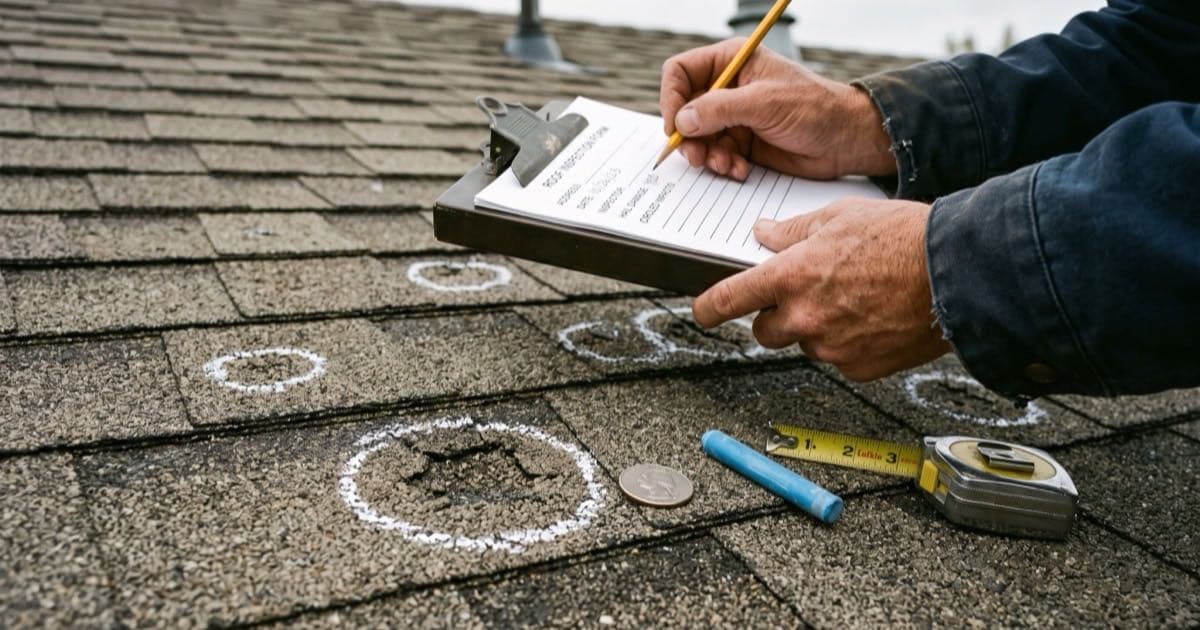
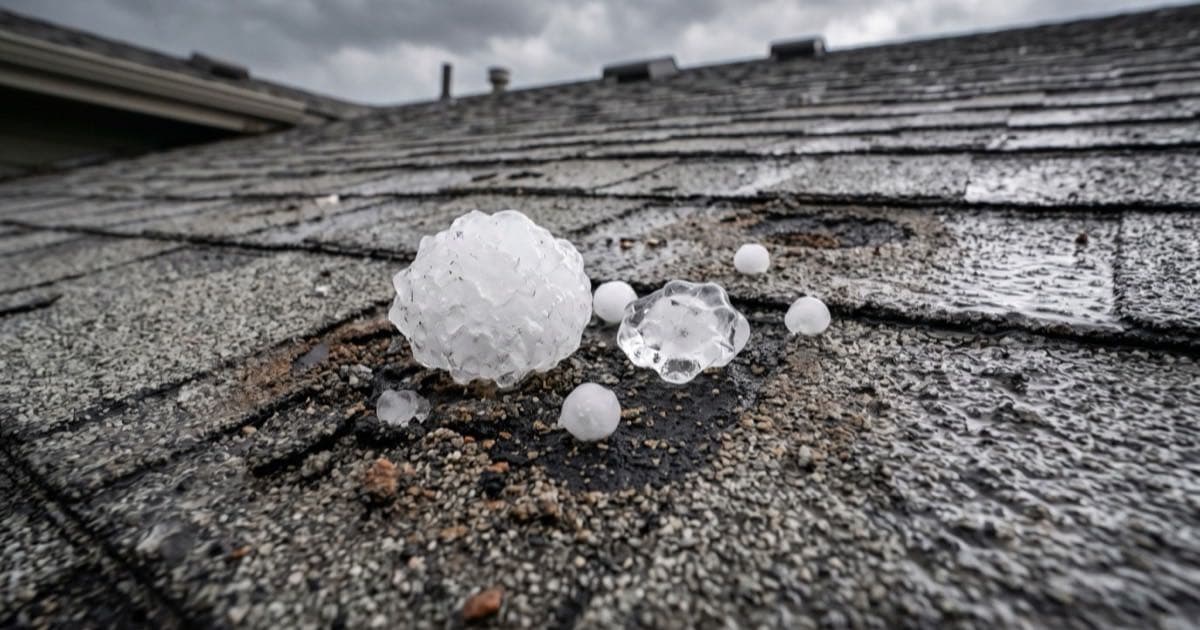
You often cannot, which is the problem. Look for dents in gutters, downspouts, vents, and window screens, and for granules collecting at downspout outlets. Those soft-metal dents are the reliable ground-level tell. Actual shingle bruising usually needs someone on the roof to confirm.
How do I spot a storm chaser?
They knock right after a storm, push you to sign the same day, quote a price without inspecting, offer to waive or absorb your deductible, and carry out-of-state plates and a phone number with no local office behind it. Absorbing a deductible is insurance fraud in Colorado. Ask where their local office is and go see it.
Do you provide emergency tarping for an active leak?
Yes. When a storm or sudden failure creates an active leak we tarp and make temporary repairs to stop water intrusion and protect the interior while a permanent repair or replacement gets scheduled. Emergency response is prioritized ahead of routine inspections.
Warranty and materials
What is actually covered, by whom, and what quietly voids it.
Warranty and materials
What is the difference between a manufacturer warranty and a workmanship warranty?
A manufacturer warranty covers defects in the material itself. A workmanship warranty covers how it was installed. Most roof failures trace to installation, not material, so the workmanship warranty is often the one that matters, and it is only as good as the company standing behind it.
Will a repair void my roof's manufacturer warranty?
It can. Repairs made by an unauthorized contractor, or with incompatible materials, void many manufacturer warranties. We are authorized to service the major commercial systems we install, so a repair to manufacturer specification preserves your coverage rather than quietly ending it.
Will a roof coating void my existing warranty?
Sometimes, and it depends entirely on the existing manufacturer and system. Some manufacturers allow an approved coating over their membrane and some treat it as an alteration that ends coverage. We check the existing warranty terms before recommending a coating, because saving a roof and losing its warranty is not a win.
How long do roof coatings last?
A properly applied silicone or acrylic system on a sound substrate typically carries a 10 or 20 year material and labor warranty and can be recoated at the end of that term rather than torn off. As an American WeatherStar Platinum Elite Contractor we install systems that qualify for those terms.
What certifications should a roofing contractor actually have?
Two kinds. Manufacturer certifications decide which warranties they can legally write for you. Professional certifications, such as Haag Certified Inspector, decide how credibly they can document damage to an adjuster. A contractor with neither can still install a roof, but cannot back it or defend your claim.
Financing
Paying for a roof when insurance covers part of it, or none of it.
Financing
Does checking my financing rate affect my credit score?
No. Checking your rate is a soft pull that takes about two minutes and leaves your score untouched. A hard inquiry only happens if you choose to move forward with a specific loan offer.
Can I finance my insurance deductible?
Yes. Financing a deductible is legal and common. What is not legal in Colorado is a contractor waiving, absorbing, or rebating your deductible, which is insurance fraud regardless of how it is framed. Financing spreads a real payment over time rather than pretending it does not exist.
Do I need home equity to finance a roof?
No. The financing we work with is unsecured personal lending, so it does not touch your home equity and does not put a lien on the property. That matters if you are already carrying a mortgage you do not want to disturb.
I have an ACV policy and a large gap. What are my options?
An ACV settlement leaves you covering depreciation on top of the deductible, which on an older roof can be substantial. Financing that gap turns a large one-time cost into fixed monthly payments so the roof gets replaced now rather than after the next storm makes it worse.
Multi-family and HOA
Roofing across many units, many owners, and a board that has to approve it.
Multi-family and HOA
Do you work with HOAs and property management companies?
Yes. HOA and multi-family work is a substantial part of what we do. We provide the documentation a board needs to make and defend a decision: full condition assessment, photo evidence per building, scoped options with costs, and a phasing plan that spreads work across budget years when needed.
How do you handle roofing on occupied apartment buildings?
With notice and sequencing. Residents get written notice before work reaches their building, vehicles are moved off the drip line, walkways stay open, debris is cleared daily rather than at the end, and each building is dried in before crews leave. We work building by building rather than opening the whole property at once.
Can a multi-family roof replacement be covered by insurance?
Often yes, under the association's master policy after a hail or wind event. These claims are larger and more scrutinized than a single-family claim, so building-by-building documentation matters more. We inspect and document every building separately rather than extrapolating from a sample.
What roof systems do multi-family properties usually need?
Most need both. Townhome and garden-style buildings carry pitched shingle or metal roofs, while the clubhouse, breezeways, and flat sections need a low-slope membrane. Getting both from one contractor avoids the finger-pointing that happens at the transition when two trades split the property.
Commercial vs residential
Why the two are different trades, and what that means when you hire.
Commercial vs residential
What is the actual difference between commercial and residential roofing?
Slope, mostly, and everything that follows from it. Residential roofs are steep and shed water, so they use overlapping materials like shingles and tile. Commercial roofs are flat or low-slope and must hold water out at every seam, so they use continuous membranes. Different materials, different failure modes, different training.
Can one contractor competently do both?
Only with separate credentials for each. Manufacturer certifications are system-specific, so a shingle certification says nothing about membrane work. We hold both: Haag Certified for residential and commercial roofs, plus manufacturer certifications spanning shingles and commercial membranes.
Why do commercial roof estimates take longer?
Because the diagnosis is harder. A commercial roof usually needs a moisture survey to map wet insulation under an intact membrane, core cuts to confirm the existing assembly, and rooftop equipment to be accounted for. A residential roof can often be scoped from a walk and a ladder in an afternoon.
Is my building commercial or residential for roofing purposes?
Go by the roof, not the use. A four-unit townhome with pitched shingle roofs is residential work. A three-story apartment building with a flat membrane roof is commercial work even though people live there. Mixed properties need both, which is the usual case in multi-family.
Not covered here? Ask us directly. A free inspection answers most roof questions faster than any article can, and we will tell you if you do not need a roof yet. Get in touch, or read more on the roofing blog.