
Residential Roofing
Why Cracked Pipe Boots Are the Most Common Colorado Residential Leak
By Ryan Sanchez, Commercial Roofing Contractor · July 6, 2026
- Pipe Boot
- Roof Leak
- Roof Repair
- Homeowner Guide
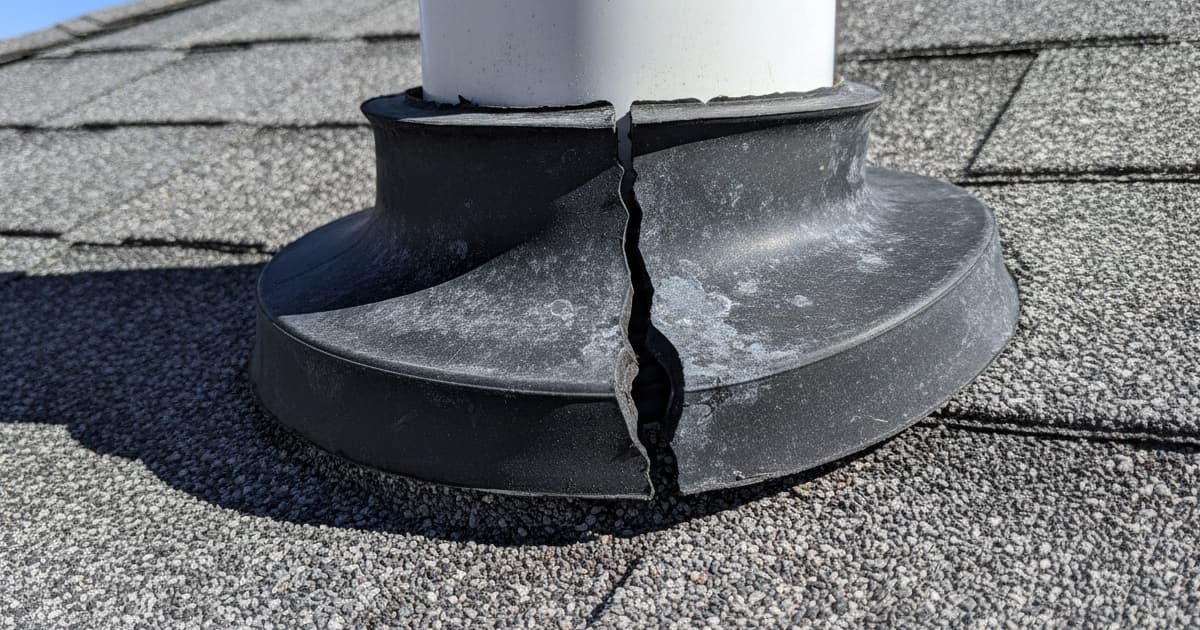
Short answer: A cracked pipe boot is the most common source of residential roof leaks in Colorado. The rubber collar that seals around a plumbing vent pipe dries out from intense high-altitude UV and gets stressed by freeze-thaw cycling, then splits, usually within 7 to 12 years in the Denver climate, long before your shingles wear out. The fix is inexpensive: a professional pipe boot replacement typically runs about $150 to $400. Catching it early prevents thousands in water damage.
Your roof can look perfectly fine from the street and still be leaking. In Colorado, the culprit is usually a small rubber part you have probably never noticed: the pipe boot. Here is why it fails so reliably here, how to spot it, and what it costs to fix.
What a Pipe Boot Is and Why It Fails First
Every home has plumbing vent pipes that poke up through the roof. Each one is sealed where it meets the shingles by a pipe boot, a flange with a rubber or neoprene collar that grips the pipe. That collar is the weak link.
The National Roofing Contractors Association and roofing contractors widely note that the large majority of roof leaks originate at flashing details like pipe boots, not from the shingle field itself. Two Colorado-specific forces wear these collars out early.
High-altitude UV
Colorado's elevation means stronger ultraviolet radiation. UV breaks down the polymer chains in the rubber collar through photo-oxidation, evaporating the plasticizers that keep it flexible. The collar turns chalky and rigid, then cracks at the highest-stress point where it grips the pipe. South-facing slopes degrade fastest because they take the most sun.
Freeze-thaw cycling
Colorado's daily temperature swings push the pipe and collar through constant expansion and contraction. Each freeze-thaw cycle works micro-cracks a little wider until the collar splits. Snow piling around roof penetrations holds moisture against the boot, and slow snowmelt can seep into cracks that would not leak in a quick rain.
The result is predictable. In the Denver climate, many standard rubber pipe boots fail in roughly 7 to 12 years, while the architectural shingles around them are rated to last far longer. The boot dies first, and the rest of the roof looks fine while water runs down the pipe into your ceiling.
How to Spot a Failing Pipe Boot
You do not need to climb onto the roof. Try these checks.
- The binocular test. From the ground, look at the black rubber collar around each vent pipe. A healthy collar looks smooth. A failing one looks like cracked, dried mud, with gaps or splits at the pipe.
- Ceiling stains near plumbing. Vent pipes usually run up from bathrooms and kitchens. A water stain near a bathroom fan, ceiling light, or kitchen is a classic pipe boot signature.
- Attic inspection during rain. With a flashlight, look for water trailing down the side of a vent pipe where it passes through the roof deck.
Even a small leak matters. Water funneling down a pipe can saturate sheathing and insulation, and mold can begin to colonize damp materials within a day or two. A boot that would have cost a few hundred dollars to replace can turn into a deck-and-drywall repair if ignored.
Pipe Boot Lifespan by Material
Not all boots are equal. If you are replacing one or re-roofing, the material choice changes how long you go before the next failure.
| Boot type | Typical lifespan in Colorado conditions | Notes |
|---|---|---|
| Standard rubber / neoprene collar | About 7 to 12 years | Cheapest, most common, and the first to fail from UV and freeze-thaw |
| High-temperature silicone collar | About 20+ years | More UV-stable than standard rubber |
| Lead boot (all-metal) | About 30+ years, often the life of the roof | Metal does not crack from UV; a long-term choice in high-sun regions |
| Perma-Boot style cover | Extends life of an existing boot | A retrofit cover that slips over a damaged collar without removing it |
Lifespans vary with sun exposure, slope, and installation quality. The pattern holds: metal and silicone outlast standard rubber, which is why many Colorado roofers recommend upgrading boots rather than matching the cheap original.
What Repair Costs
A professional pipe boot replacement is one of the most affordable roof repairs. Reported ranges put it at roughly $150 to $400 per boot, with the part itself often only $10 to $40 and most of the cost in labor, access, and safety. A large share of that is simply the minimum service charge for a roofer to drive out, set up safely, and walk your roof.
A few practical points:
- Replace all boots when you re-roof. If your shingles are worn from years of sun and freeze-thaw, your boots have taken the same beating. Any reputable roofer includes new boots in a re-roof. A crew that reuses old boots to shave cost is a warning sign.
- Match or upgrade. If you are only replacing a failed boot on an otherwise good roof, you can match what is there or upgrade to silicone or lead for longer life. If you plan to re-roof within a couple of years, a basic replacement may be fine in the meantime.
- Do not just smear sealant on it. A bead of caulk over a cracked collar is a temporary patch that hides the problem and often fails again fast. The durable fix is replacing the boot.
Because roof falls are a serious injury risk and proper shingle layering matters for a watertight result, this is a repair most homeowners are better off leaving to a licensed roofer. Commercial Roofing Contractor handles pipe boots and other flashing leaks across the Denver Metro, Front Range, and Western Slope, and if a failing boot points to a larger problem, we handle residential roof repair, full residential and commercial replacements, and any insurance claim that comes with storm damage. Our Haag-certified inspectors can tell you whether a boot is the whole story or the first sign of a bigger issue, and you can verify our certifications before you call.
Frequently Asked Questions
How long do pipe boots last in Colorado?
Standard rubber pipe boots commonly last about 7 to 12 years in the Denver-area climate, far less than the shingles around them, because high-altitude UV and freeze-thaw cycling break down the rubber collar early.
How do I know if my leak is from a pipe boot?
Look for a water stain on the ceiling near a bathroom or kitchen, since vent pipes run up from those rooms. From the ground, use binoculars to check whether the rubber collar around each vent looks cracked or split. In the attic during rain, look for water running down a vent pipe.
How much does it cost to replace a pipe boot?
A professional replacement typically runs about $150 to $400 per boot. The part is inexpensive; most of the cost is labor, roof access, and safety. If a quote runs far higher than that without decking damage, ask the contractor to show you the underlying damage before you approve the work.
Should I use a rubber, silicone, or lead boot?
Standard rubber is cheapest but fails first. High-temperature silicone lasts 20-plus years, and lead boots can last 30-plus years or the life of the roof. In high-sun Colorado, upgrading to silicone or lead is often worth it.
Can I just put sealant over a cracked pipe boot?
Sealant is a temporary patch that hides the problem and often fails again quickly. The durable fix is replacing the boot, which restores a proper watertight seal.
Should I replace pipe boots when I get a new roof?
Yes. Old boots have endured the same UV and freeze-thaw as your worn shingles. A reputable roofer includes new boots in any re-roof, and reusing old ones is a common cause of leaks within months of a new roof.
Is replacing a pipe boot a DIY job?
It is technically simple, but it involves working on a roof, which carries a real fall risk, and improper shingle layering can cause new leaks. Most homeowners are better off hiring a licensed roofer.


Talk to the team nearest you: our Denver office, our Grand Junction office, or our Scottsbluff office.