Commercial Roofing
TPO vs EPDM for Colorado Commercial Buildings
By Ryan Sanchez, Commercial Roofing Contractor · May 29, 2026
- TPO
- EPDM
- Single-Ply Membranes
- Material Comparison
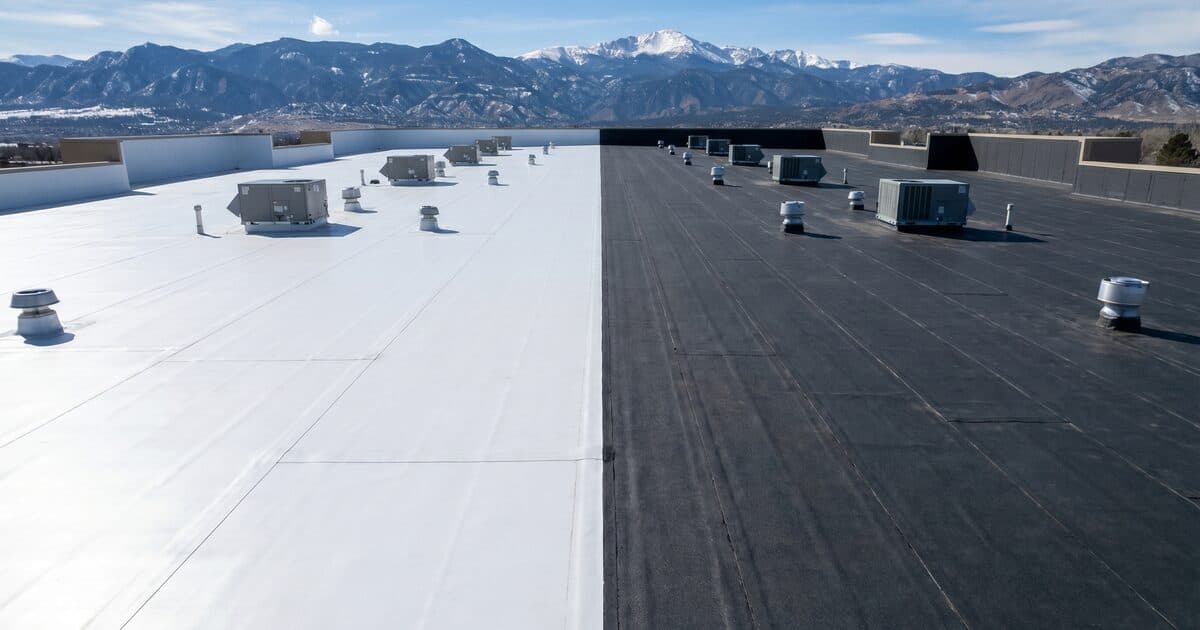
Short answer: For most Colorado commercial buildings, TPO and EPDM both work, but they win in different situations. Choose TPO (a white, heat-welded single-ply membrane) when you want reflectivity to cut cooling load, strong puncture resistance, and tight seams for snowmelt and wind uplift. Choose EPDM (a black synthetic rubber membrane) when cold-weather flexibility, hail elasticity, and a lower installed cost matter most. Installation quality and membrane thickness affect lifespan more than the material name.
Picking a flat roof membrane for a building in Denver, Aurora, or Grand Junction is not about which product is "best" in the abstract. It is about how each membrane handles Colorado's specific stresses: intense high-altitude UV, hail, daily thermal swings, snow load, and rooftop foot traffic. Here is how TPO and EPDM compare on the factors that actually drive the decision.
What TPO and EPDM Actually Are
TPO (Thermoplastic Polyolefin) is a single-ply membrane, usually white, built in three layers: a UV-resistant top, a polyester-mesh reinforcement, and a flexible base. Its defining feature is the heat-welded seam, which fuses sheets into a continuous, watertight bond. TPO comes in 45-mil, 60-mil, and 80-mil thicknesses.
EPDM (Ethylene Propylene Diene Monomer) is a synthetic rubber membrane, typically black, in service on commercial roofs since the 1970s. It is prized for elasticity and cold-weather performance. Seams are traditionally glued or taped rather than welded, though seam technology has improved.
How They Perform in Colorado Conditions
UV and high-altitude sun exposure
Colorado's elevation means stronger UV than most of the country. TPO's reflective white surface bounces a large share of solar radiation, which reduces rooftop temperature and cooling load. Industry reporting commonly cites reflectivity in the range of 75 to 80 percent for white TPO. Black EPDM absorbs heat instead, running far hotter on a summer afternoon. White or "cool" EPDM exists but narrows EPDM's cost advantage. Both modern membranes are formulated for UV resistance, so neither fails quickly from sun alone when installed correctly.
Hail
Colorado's Front Range is one of the most hail-prone regions in North America. EPDM's rubber elasticity lets it absorb hail impact and flex without fracturing, which is a real advantage in Hail Alley. TPO generally offers higher puncture resistance for foot traffic and debris, but thinner TPO can be more vulnerable to large hail. For hail country, thicker membranes (60-mil or 80-mil) help regardless of which you choose.
Thermal cycling and cold
Colorado roofs can swing more than 100 degrees between a winter night and a sunny afternoon, and surface temperatures climb high in summer. EPDM stays flexible in extreme cold, remaining pliable to very low temperatures, which makes it forgiving through freeze-thaw cycles. TPO's welded seams resist the seam stress that thermal movement creates, but some TPO formulations can stiffen in deep cold if not specified correctly. Both handle Colorado's range when the right product and thickness are specified.
Foot traffic and rooftop equipment
Buildings with HVAC units, frequent service access, or solar arrays put boots and tools on the roof. TPO's puncture and tear resistance gives it an edge for high-traffic roofs and equipment-heavy layouts. EPDM is forgiving of dropped tools and forklift-adjacent abuse but is generally considered slightly less puncture-resistant than reinforced TPO.
Chemical exposure
If your building has grease exhaust, kitchen vents, or rooftop chemical exposure, both TPO and EPDM can degrade. In those specific cases a PVC membrane is often the correct specification instead of either one. For typical office, retail, warehouse, and industrial roofs in Colorado, this is rarely the deciding factor.
TPO vs EPDM: Side-by-Side Comparison
| Factor | TPO | EPDM |
|---|---|---|
| Color and reflectivity | White, reflective; lowers cooling load | Black (standard); absorbs heat. White EPDM available at added cost |
| Seam method | Heat-welded, continuous bond | Glued or taped (welding not standard) |
| Hail performance | Good puncture resistance; thin membranes more hail-vulnerable | Excellent elasticity, flexes under impact |
| Cold-weather flexibility | Good; specify cold-rated product | Excellent, stays flexible in deep cold |
| Foot traffic / punctures | Strong, well-suited to equipment-heavy roofs | Good, slightly less puncture-resistant |
| Typical service life | About 20 to 30 years, install-dependent | About 25 to 40 years, install-dependent |
| Energy benefit | High in cooling-driven buildings | Lower; can suit heating-driven buildings |
| Relative installed cost | Comparable; welding adds labor and equipment | Often slightly lower upfront |
Cost and lifespan ranges vary widely by membrane thickness, insulation, roof size, and crew skill, so treat the table as directional. Published installed-cost ranges across the industry run roughly $4 to $12 per square foot for either system depending on the buildup, and both can exceed 25 years when installed well. The most important variable is not the brand on the membrane. It is the quality of the seams, flashings, and edge metal.
Which Should a Colorado Building Owner Choose?
Lean TPO if:
- Your building is cooling-driven and you want lower summer energy bills.
- You have heavy rooftop foot traffic, HVAC equipment, or a planned solar array.
- You want welded seams for snowmelt and wind-uplift performance.
Lean EPDM if:
- Cold-weather flexibility and freeze-thaw forgiveness are your top priority.
- Hail elasticity matters more than reflectivity for your roof.
- A lower upfront cost fits the project budget and the building is heating-driven.
For a specific recommendation, the membrane should be matched to your building's use, deck condition, insulation, and budget. Commercial Roofing Contractor specializes in commercial roof replacements (and residential work too), and as a GAF Certified Commercial, Johns Manville Peak Advantage, and Mule-Hide authorized contractor, we can install and warranty both TPO and EPDM systems. You can review our manufacturer certifications for details. Our Denver office handles Front Range commercial roofs, our Grand Junction office covers the Western Slope, and our Scottsbluff office covers the Nebraska Panhandle. Call Denver at (720) 893-7663, Grand Junction at (970) 877-7663, or Scottsbluff at (308) 536-7663 to request a free roof inspection.
Frequently Asked Questions
Is TPO or EPDM better for hail in Colorado?
EPDM's rubber elasticity absorbs hail impact and flexes without fracturing, which is an advantage in Hail Alley. TPO resists punctures well but thinner membranes can be more vulnerable to large hail. In hail country, a thicker 60-mil or 80-mil membrane of either type improves resilience.
Which membrane lasts longer?
Both commonly exceed 25 years when installed properly. EPDM has the longer track record and can reach 40 years in good conditions, while modern TPO typically runs 20 to 30 years. Installation quality and membrane thickness matter more than the material choice.
Does TPO really lower energy bills?
In cooling-driven buildings, TPO's reflective white surface reduces rooftop heat gain and cooling load compared to black EPDM. The savings depend on your building, insulation, and climate zone, so the benefit is larger for an air-conditioned warehouse or retail box than for a heating-dominated building.
Can I install TPO or EPDM over my existing roof?
Sometimes, if the deck is structurally sound and the existing roof is dry. A moisture scan and inspection are needed first. If the substrate is wet or failing, a recover will trap problems and a tear-off is the better path. See our guide on roof coatings vs tear-off for how to evaluate that decision.
How often should a commercial membrane roof be inspected?
At least twice a year, ideally spring and fall, plus after any major hail or wind event. Catching seam separation or flashing failure early is far cheaper than repairing water-damaged insulation and deck.
What thickness should I specify in Colorado?
For hail and foot traffic, many Colorado commercial roofs use 60-mil as a practical baseline, with 80-mil for high-traffic or high-exposure roofs. The right thickness depends on the building and warranty requirements, so confirm with your contractor and the manufacturer.
Related Resources
Talk to the team nearest you: our Denver office, our Grand Junction office, or our Scottsbluff office.