
Commercial Roofing
Commercial Roof Leaks in Winter: Emergency Repair and Inspections in Colorado and the Nebraska Panhandle
By Chris Sanchez, Owner and Chief Executive Officer · Reviewed by the CRC team · November 14, 2026
- Commercial Roofing
- Roof Leak
- Flat Roof
- Emergency Repair
- Winter
Short answer: Flat and low-slope commercial roofs leak in winter when meltwater has nowhere to go. Drains and scuppers freeze or clog, water ponds against seams and flashing, and nights below freezing open the small gaps it gets into. When a leak starts, protect the people and inventory below, keep staff off an icy roof, document it, and call for emergency repair. A temporary repair stops the water in any season, and the permanent fix follows when the weather and materials allow.
A commercial roof that got through summer without a drip can start leaking the first week of a real winter. The roof did not suddenly fail. Winter puts water on it in a different way. Here is what changes, how winter differs across our offices in Colorado and the Nebraska Panhandle, and what to do when a leak starts.
Why Commercial Roofs Leak in Winter
Frozen and blocked drains
A low-slope roof depends on its drains, scuppers and gutters. In winter they freeze, or fill with ice and debris, and meltwater backs up across the roof. Water that would have drained in an hour now sits against every seam and flashing it reaches, and refreezes at night. Our roof drainage page covers how drains, crickets and tapered insulation keep water moving.
Meltwater that refreezes
Sun and heat from the building melt the snow during the day. At night the water refreezes at the coldest points: drains, roof edges, gutters and the base of parapet walls. Ice that forms in a seam or under a flashing edge expands and pries it open a little further each cycle.
Freeze-thaw at seams, flashing and penetrations
Most commercial leaks start at seams, flashing and penetrations rather than in the open membrane, as we explain in commercial flat roof leaks. Winter works those same details harder: rooftop unit curbs, pipe and conduit penetrations, parapet coping, and the laps in TPO, EPDM and modified bitumen roofs. On metal roofs, the fasteners and panel laps are the usual entry points.
Snow, drifts and damage from clearing
Snow drifts against parapets and rooftop units, which holds water right at the flashing. Heavy snow also adds weight that a building was designed for up to a point, and clearing it can do more harm than the snow: metal shovels, ice chipping and foot traffic puncture membranes.
Condensation that looks like a leak
Not every winter drip is a roof leak. Warm, moist air inside a building can condense on the cold underside of the roof deck and drip. The fix for that is ventilation and vapor control, not roof repair, which is why finding the real source comes before any repair.
What Winter Looks Like at Each of Our Offices
The figures below are the 1991 to 2020 Climate Normals from NOAA's National Centers for Environmental Information unless noted.
| Office | Average snow per year | Snowiest months | Nights at or below 32°F |
|---|---|---|---|
| Denver | About 47 to 49 inches | March, then February and November | About 156 |
| Grand Junction | 17.7 inches | December and January | About 137 |
| Scottsbluff | 42.5 inches | December, February and March | About 174 |
Denver and the Front Range
Denver's heaviest snow comes in March, according to the National Weather Service in Boulder, and it can leave fast. Colorado State University's CIRA notes that with a chinook wind “a foot of snow may disappear in a few hours.” On a flat roof that is a sudden load of meltwater on drains that may still be frozen. Our Denver office covers the metro and the Front Range.
Grand Junction and the Western Slope
The Grand Valley floor averages 17.7 inches of snow a year, but its roofs still go through about 137 freezing nights, so seams and flashing take the same freeze-thaw wear. The higher towns are a different job: Rifle publishes a ground snow load of 47 psf and Glenwood Springs 50 psf, as we cover on the Rifle and Glenwood Springs pages. Our Grand Junction office covers the Western Slope.
Scottsbluff and the Nebraska Panhandle
Scottsbluff averages 42.5 inches of snow a year and about 174 nights at or below freezing, the most of our three offices, with the first freeze arriving in early October on average. That long freezing season is hard on seams, flashing and drains on warehouses, shops, farm buildings and schools across the Panhandle. Our Scottsbluff office covers western Nebraska.
What to Do When a Commercial Roof Starts Leaking
- Protect people, inventory and equipment. Move what you can, cover the rest, and set out containers. Keep people clear of a sagging ceiling tile or wet electrical equipment, and have power to affected circuits shut off if water is near them.
- Keep staff off the roof. An icy roof is a fall hazard, and chipping ice away from a drain is one of the easiest ways to cut a membrane.
- Document it. Photograph the leak, the stain, any damaged stock and the date and time. Note whether it started after snow, a thaw or wind. That record helps diagnose the leak and supports any insurance claim.
- Call for emergency repair. We prioritize active leaks at all three offices.
Emergency Repair in Cold Weather
When an active leak threatens a building, we provide emergency tarping and temporary repair to stop the water and protect the interior and contents while the permanent repair or replacement is scheduled. That works in any weather.
The permanent fix depends on the roof and the temperature. Many repairs can be made on a dry winter day. Adhesives, primers, sealants and roof coatings each have a minimum application temperature set by the manufacturer, and work that needs one of them waits for a window that meets it, because a repair applied too cold does not bond and fails again. Our commercial roof repair page covers the systems we repair.
Finding the Leak Before Fixing It
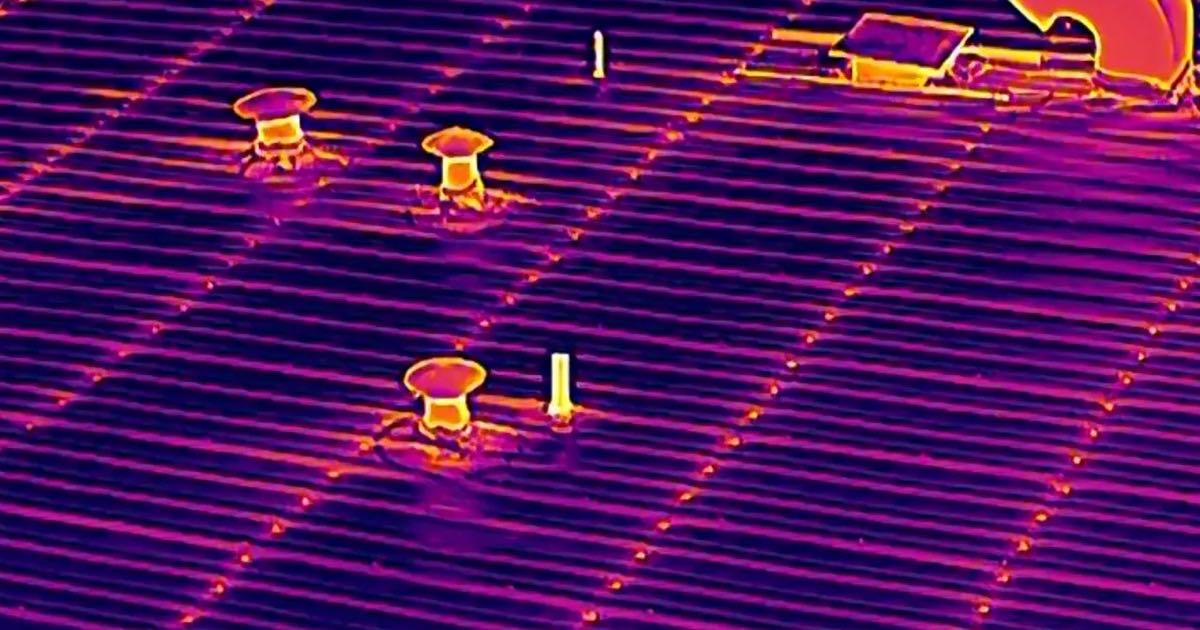
On a flat roof, water travels under the membrane and along the deck before it drips, so the ceiling stain is often far from the opening. Repairing the spot above the stain misses it. A physical inspection of seams, flashing and penetrations, backed by moisture scanning, finds the actual entry point and any wet insulation. The photo at the top of this post is from a thermal imaging roof inspection on a metal roof in Grand Junction, where a drone scan picked out the hidden leak points at seams and fasteners before any work began.
A Winter Inspection Costs Less Than a Winter Leak
The cheapest winter leak is the one found in the fall. A pre-winter inspection clears and checks drains and scuppers, looks at every seam, curb and penetration, and checks parapet coping and flashing before snow covers them. Our guide to commercial roof maintenance lists what a maintenance visit covers. We offer free commercial roof inspections with a written report and photographs, and we typically schedule within a day or two of your call, sooner for an active leak.
Leak at home instead? Our homeowner guide to winter roof leaks and emergency tarping covers ice dams, pipe boots and what to do when water comes in.
Commercial Winter Roof Leak FAQs
Why does my flat roof leak in winter but not in summer?
Winter adds three things summer does not: snow that melts slowly for days, drains and scuppers that freeze or clog so meltwater ponds, and nights below freezing that open seams and flashing. A weak spot that sheds a summer storm can sit under standing meltwater for a week in January.
Can a commercial roof be repaired in winter?
Usually, yes. Emergency tarping and temporary repairs stop water in any season, and many permanent repairs can be made on a dry day. Adhesives, primers and coatings have minimum application temperatures set by the manufacturer, so some permanent work waits for a warmer window while the temporary repair holds.
Should we have snow removed from our flat roof?
Only when there is a reason, and only by a crew that knows roofs. Whether the snow is too heavy is a structural question answered by the building's design loads. Metal shovels and ice chipping puncture membranes, so a careful crew leaves a protective layer of snow over the roof surface.
The ceiling is dripping but the roof looks fine. Where is the leak?
Often somewhere else. Water travels under a membrane and along the deck before it drips, so the stain can be far from the opening. In cold weather, condensation on the underside of the roof deck can also look like a leak. Moisture scans and thermal imaging find where water is actually entering.
How fast can you respond to a commercial roof leak?
Active leaks and storm damage are prioritized. We typically schedule an inspection within a day or two of your call, sooner for an active emergency, from the nearest of our Denver, Grand Junction and Scottsbluff offices.
Related Resources
Talk to the team nearest you: our Denver office for the Front Range, our Grand Junction office for the Western Slope, or our Scottsbluff office for the Nebraska Panhandle.