
Commercial Roofing
What Commercial Roof Maintenance Actually Involves in Colorado
By Chris Sanchez, Commercial Roofing Contractor · August 24, 2026
- Commercial Roofing
- Roof Maintenance
- Roof Inspection
- Flat Roof
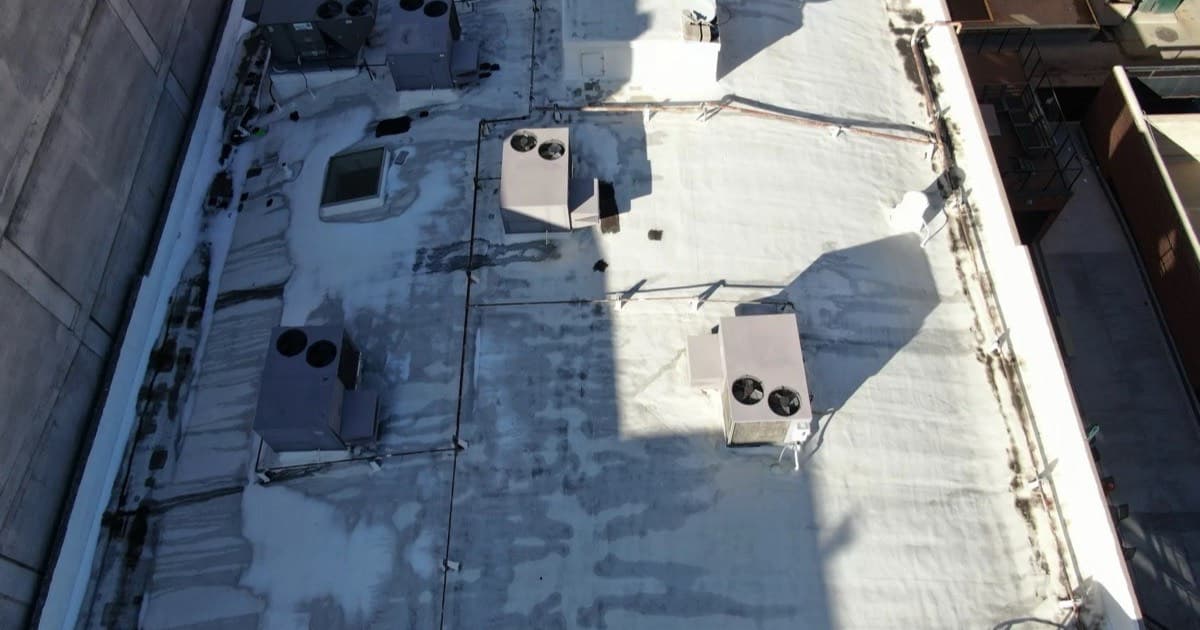
Short answer: Commercial roof maintenance is a scheduled visit that keeps water moving off the roof and catches small failures while they are still small. Drains and scuppers get cleared, seams and flashings get checked, rooftop equipment and its curbs get inspected, and the condition gets photographed so this year can be compared with last year. Twice a year is the normal cadence in Colorado, plus a visit after any serious hail or wind.
Almost every expensive commercial roof we are called out to had a cheap version of the same problem twelve or eighteen months earlier. A drain packed with grit. A seam lifting at one corner. A pitch pan that had dried out and shrunk away from the pipe it was sealing. None of those are emergencies on the day they start, and none of them announce themselves from the parking lot. They become emergencies once water has been getting into the insulation for a year and the first stain finally shows up on a tenant's ceiling tile.
That is the whole argument for maintenance on a low-slope roof, and it is worth being specific about what the work actually is.
Why Colorado is hard on a low-slope roof
A commercial roof here is not just aging, it is being worked. Four things drive that, and they compound:
- Hail. The Front Range sits in the part of the country where damaging hail is a routine seasonal event rather than a rare one. Hail bruises membrane and splits the coating on metal long before it punches a visible hole.
- Altitude and ultraviolet exposure. Thinner atmosphere means more UV reaching the roof surface, which is what degrades a membrane's top layer, chalks coatings, and makes older asphaltic surfaces brittle.
- Freeze-thaw cycling. Colorado gets sunny days and cold nights through a long shoulder season, so a roof can cross freezing and back again repeatedly in a single week. Every cycle expands whatever water has found its way into a seam or a crack.
- Wind. Wind finds edges. It works at loose flashing, lifts poorly secured coping, and drives rain sideways into details that shed water perfectly well when it falls straight down.
What a maintenance visit actually covers
The order varies by roof, but the work is consistent. A visit that skips the unglamorous first item is not maintenance.
- Drainage first. Drains, scuppers, downspouts and gutters get cleared of grit, leaves, and the gravel that migrates across a roof over a season. A blocked drain is the single most common cause of ponding, and ponding is what turns a sound roof into a wet one.
- Seams and laps. On single-ply membrane the seams are the roof's weakest line. They get walked and checked for lifting, fishmouths, and separation.
- Flashings and terminations. Base flashings at walls and parapets, counterflashing, coping and edge metal. Wind and thermal movement work at all of them.
- Penetrations and details. Every vent, pipe, curb, drain and support bracket is a hole in the roof that somebody sealed once. Pitch pans dry out and shrink. Pipe boots crack. These are the details that leak first and are cheapest to fix.
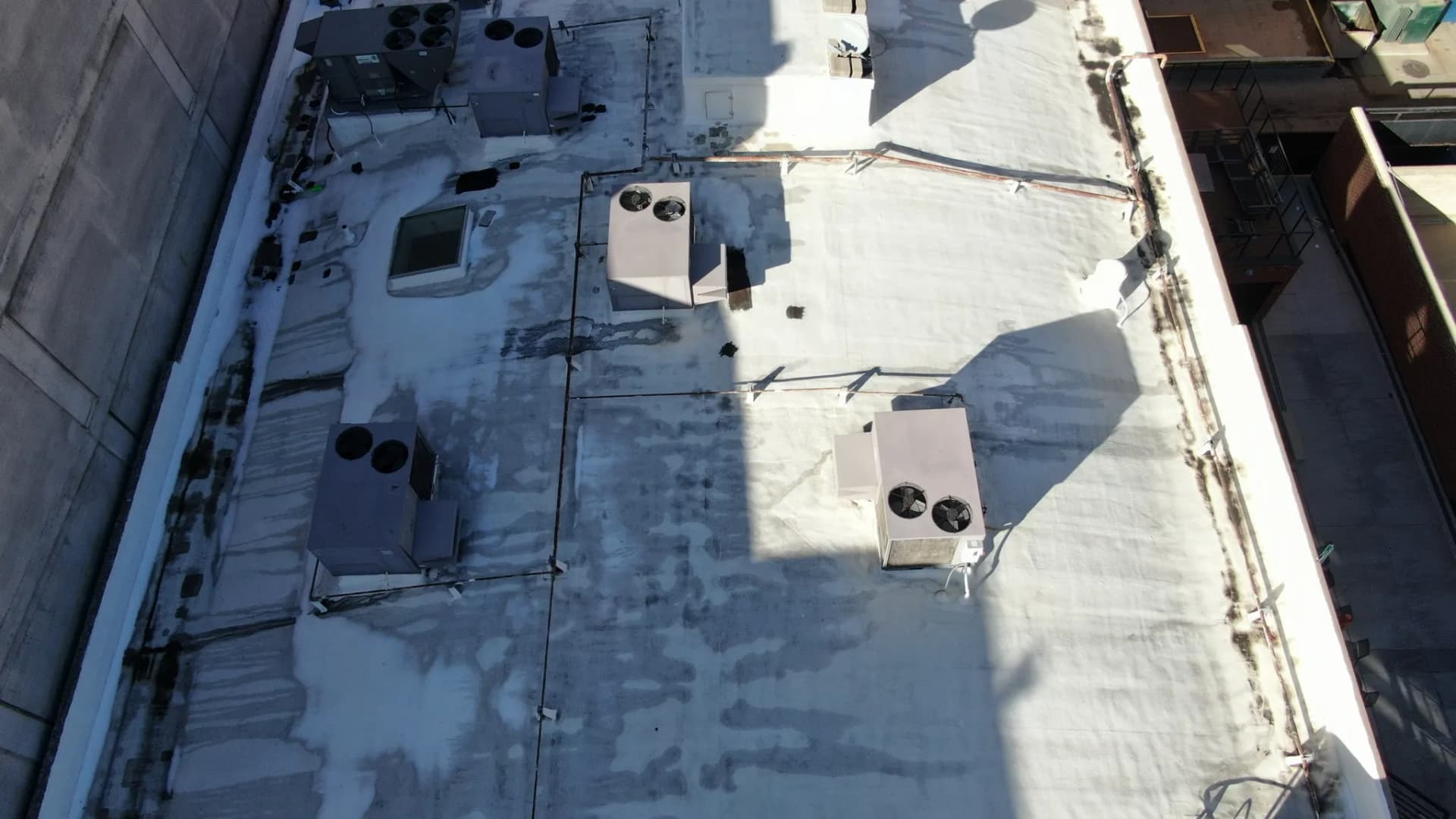
- Rooftop equipment. HVAC units, their curbs, and their condensate lines. A unit dripping onto the membrane will destroy the roof beneath it, and service technicians working on that unit are a common source of new punctures and dropped fasteners.
- The field of the roof. Punctures, blisters, open laps, hail bruising, surface degradation, and any area holding water more than a day or two after rain.
- Documentation. Dated photographs and notes, so the roof has a history. This is the part owners undervalue and then need, both for planning and for a claim.
How often, and when
Twice a year is the working cadence: once in spring, after the freeze-thaw season has done its worst and before the summer storms, and once in autumn, so the roof goes into winter with clear drains and sound details. Buildings with heavy rooftop equipment, a lot of foot traffic, or overhanging trees earn more frequent attention.
The visit that matters most in Colorado is the unscheduled one. After significant hail or a serious wind event, the roof should be looked at whether or not anything is leaking. Hail damage on a membrane is frequently invisible from inside the building for a long time, and insurance policies do not wait indefinitely for you to notice. If you are working through that situation, our guide on what size hail actually damages a roof covers what the thresholds really are.
What CRC does, stated plainly
We do maintenance work, and we do not sell a packaged plan with fixed tiers. There is no bronze, silver and gold to choose between, because a 4-year-old membrane on a warehouse and a 22-year-old asphaltic roof under six rooftop units do not need the same visit at the same interval. We schedule around the roof you have.
Where a scan is warranted we use one. A thermal imaging roof inspection maps wet insulation across the whole roof without a single test cut, which is how you find out whether a roof needs three targeted repairs or a section replaced. Where the roof is sound but the surface is spent, a roof coating can extend it rather than replace it. Where a detail has failed, it is a commercial roof repair and nothing more.
What gets expensive when nobody looks
The cost of neglect is rarely the roof itself at first. It is everything the water reaches on the way through.
- Wet insulation. Saturated insulation does not dry out under a membrane. It loses its thermal value, so the building costs more to heat and cool, and it stays wet against the deck.
- Deck deterioration. Steel deck corrodes and wood deck rots. Once the deck is involved, a repair becomes a replacement, and the price is no longer set by the roof area that leaked.
- Tenant disruption. Interior damage, inventory loss, and the cost of working around a leak in an occupied building are usually larger than the roofing invoice would have been.
- Warranty exposure. Manufacturer warranties generally require the owner to keep drains clear and repair damage promptly. Neglect can leave you holding a warranty you can no longer claim on.
- A weaker insurance position. An adjuster looking at a roof with no maintenance history and no photographs is being invited to call the damage long-term wear. Our guide to what to expect from a roof insurance adjuster covers how that conversation tends to go.
If your building has a low-slope roof and you cannot say when anyone last walked it, that is the answer to whether it is due. CRC works out of offices in Denver, Grand Junction and Scottsbluff, and inspections are free. You can see the full range of commercial roofing services we provide, or read more about what causes commercial flat roof leaks in Colorado and how to decide between repairing and replacing.
Frequently Asked Questions
How often should a commercial roof be inspected in Colorado?
Twice a year is the usual cadence: once in spring after the freeze-thaw season, and once in autumn before winter loading. In Colorado you add an unscheduled visit after any significant hail or wind event, because the damage that matters most is the damage that arrives on a single afternoon.
What does a commercial roof maintenance visit include?
Clearing drains, scuppers and gutters, checking every seam and flashing, inspecting the details around curbs, vents and rooftop equipment, looking for punctures and ponding, checking the parapet and coping, and documenting the roof's condition with photographs so this year can be compared with last year.
Does CRC offer a roof maintenance plan?
CRC does maintenance work, but we do not sell a packaged plan with fixed tiers. We schedule around your building, your roof system, and its age. Call the office nearest you and we will tell you what your roof actually needs rather than which tier to buy.
Is roof maintenance worth it on a roof that is near the end of its life?
Often yes, but the goal changes. On a roof with years left, maintenance protects the service life you paid for. On a roof near the end, it buys you control of the timing so that replacement is a budgeted capital project rather than an emergency after the first leak reaches a tenant space.
Will neglecting maintenance void a roof warranty?
It can. Most manufacturer warranties on commercial membrane require the owner to keep the roof clear, keep drains functional, and repair damage promptly, and several require documented inspections. A warranty claim is where an owner usually discovers the requirement, which is the worst moment to find out.
What does ponding water do to a commercial roof?
Standing water adds weight, accelerates the breakdown of the membrane and its seams, and drives dirt and biological growth into the surface. Colorado's freeze-thaw cycling makes it worse: water that ponds by day and freezes overnight expands in every seam and crack it has found.
Talk to the team nearest you: our Denver office, our Grand Junction office, or our Scottsbluff office.