
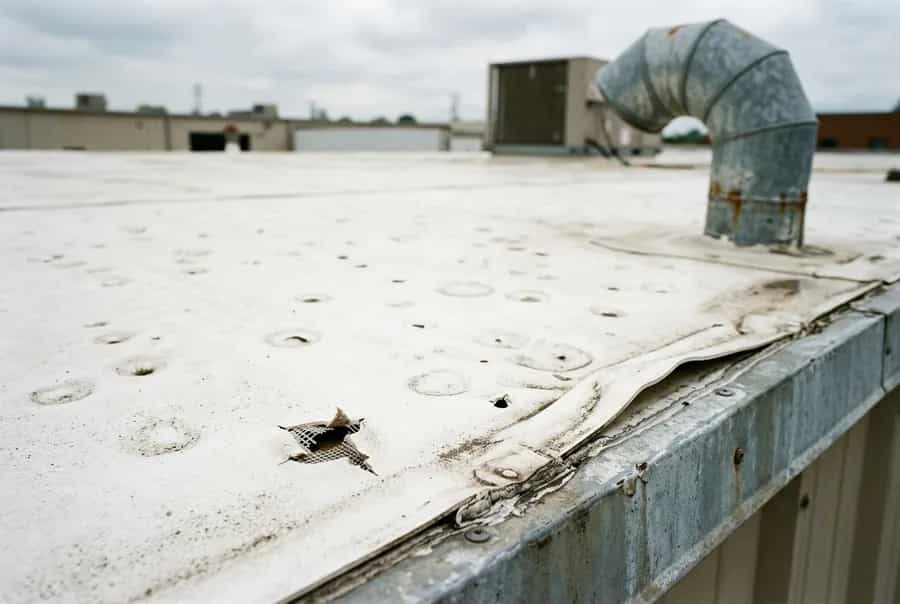
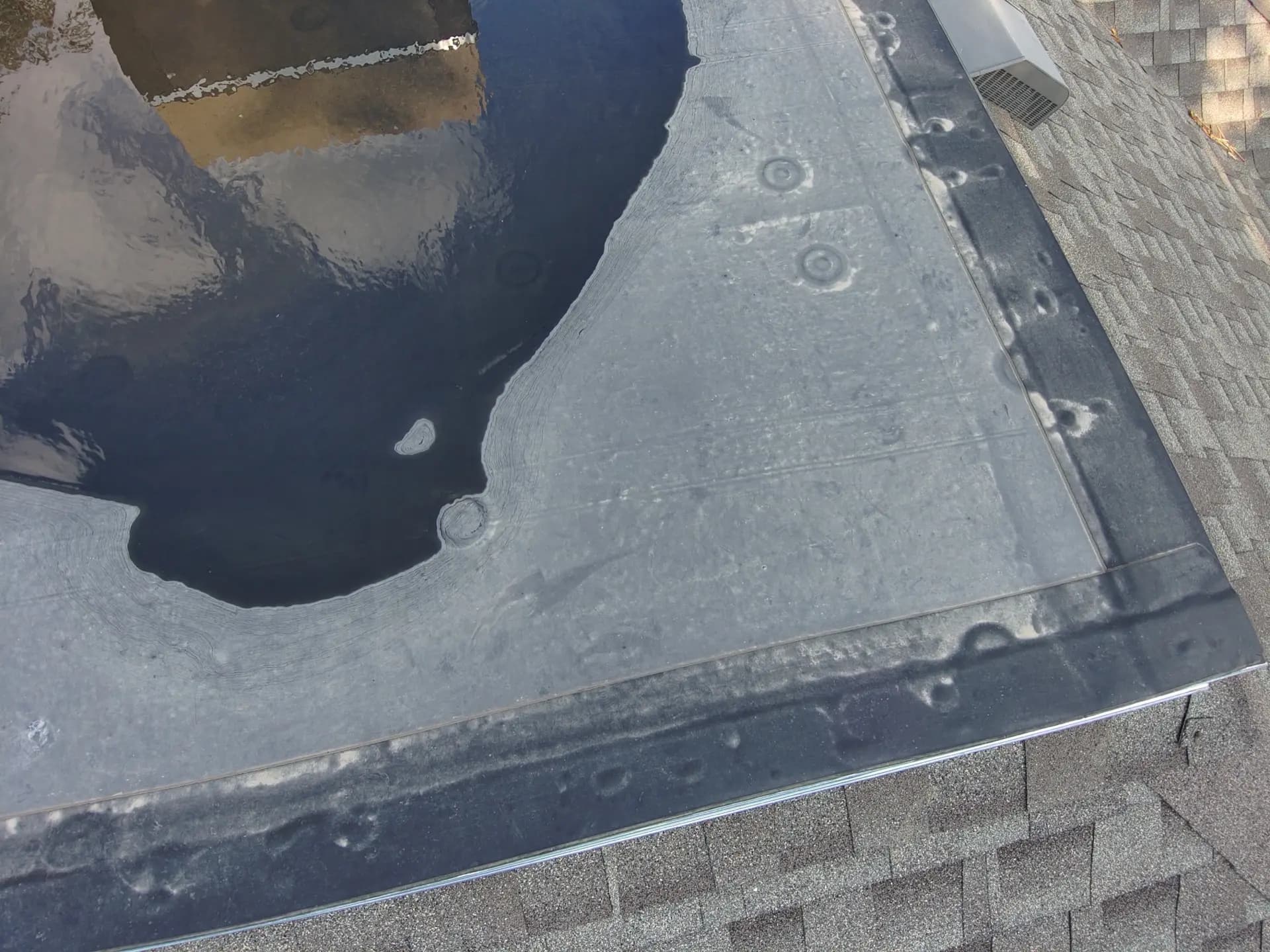
Roof drainage is the drains, scuppers, conductor heads and downspouts that move water off a low-slope commercial roof, plus the slope that gets it there. When one of them stops working the roof ponds, and standing water is what turns a sound membrane into a leak. We assess drainage on every commercial inspection across Colorado and Nebraska.
What Ponding Water Actually Costs You
The working definition in the trade is water still standing more than 48 hours after the rain stops. Inside that window a roof is doing its job. Past it, the roof is telling you something.
The number most building owners have not run is the weight. Water weighs about 5.2 pounds per square foot for every inch of depth. Two inches across a 40 by 60 foot bay is roughly 25,000 pounds resting on that section of deck. And ponding compounds: a deck that deflects under the load creates a deeper low spot, which holds more water, which deflects it further. That is why we treat standing water as a deck question first and a membrane question second, and why a drainage problem rarely stays the same size.
What We Replace, and Why We Replace It With the Roof
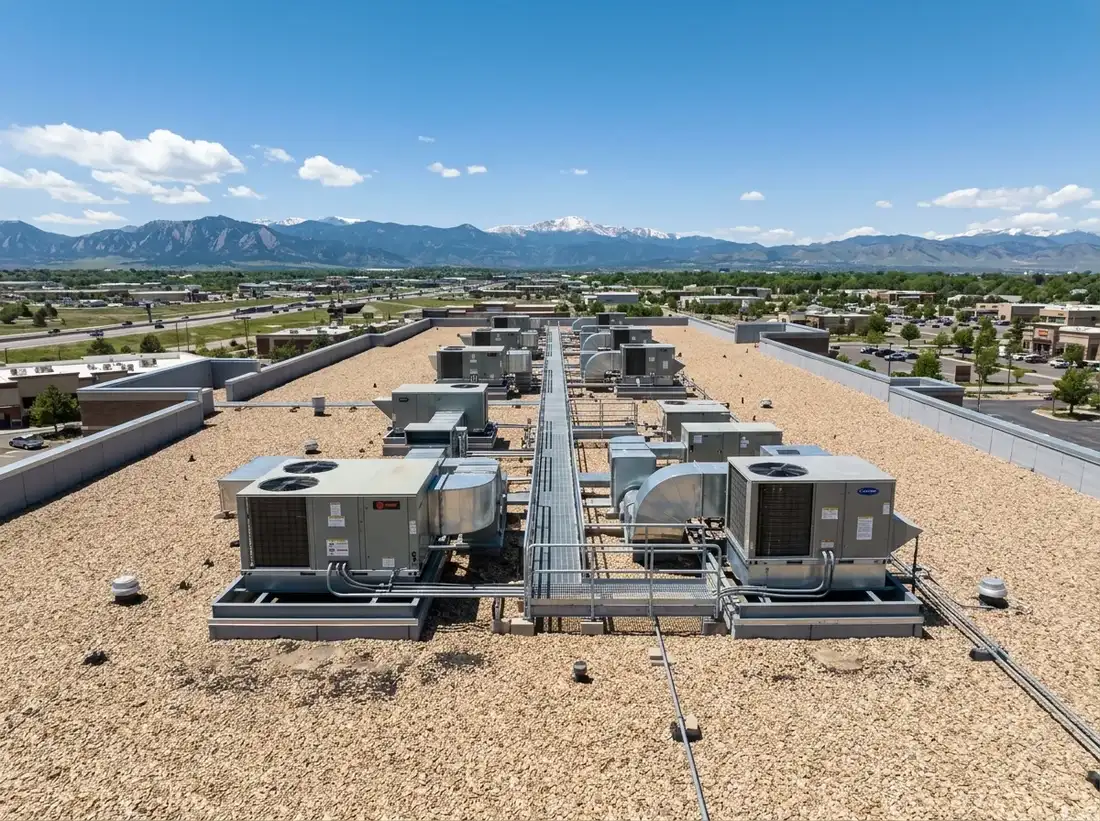
Drain bowls, strainers and clamping rings, scuppers, conductor heads, and downspouts. We replace them as part of the roof scope rather than flashing a new roof into worn-out drainage. A new membrane tied into a crushed drain or a dented scupper fails at exactly the point it failed before, and it does it inside the warranty period.
Where the roof itself is sound, drainage can usually be corrected on its own. As a rule of thumb, a roof showing less than about 25 percent saturation on a moisture scan is a repair candidate: rebuild the drain assembly, add or enlarge scuppers, or build the low spot back up with tapered insulation so water reaches the drain instead of sitting in the same place. Where saturation is widespread, the drainage work happens as part of a commercial roof replacement instead of ahead of one.
Drainage Is a Storm Claim Item, and It Gets Missed
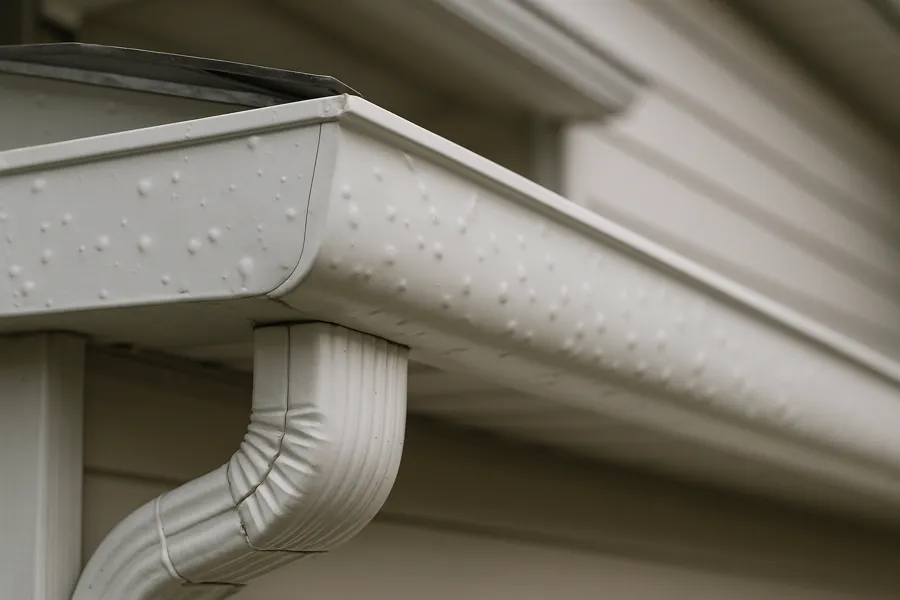
Hail dents scuppers, conductor heads, gutters and downspouts. Wind separates joints and pulls downspouts off the wall. These are roof-system components, they are damaged in the same event, and they belong in the same claim, but a first estimate written off a quick look at the field of the roof routinely leaves them out. We photograph drainage components separately during a storm inspection for exactly that reason, and file for them as part of the scope.
Storm damage insurance claim support covers how that documentation works, and how supplements recover scope a carrier's first estimate missed.
Sizing Drainage for This Climate, Not a National Average
Drainage capacity is designed against how hard it actually rains at a specific location, and rainfall intensity is not the same number across the Front Range, the Western Slope, and the Nebraska Panhandle. The primary source for that is NOAA's Precipitation Frequency Data Server, the National Weather Service tool that publishes NOAA Atlas 14 precipitation frequency estimates for Colorado and Nebraska down to a point location.
Which Code Governs a Commercial Reroof Here
On the commercial side the governing document is the International Building Code as your city adopts it, and Chapter 15 is the part that covers roof assemblies and reroofing. Drainage requirements travel with it, which is why the answer to "what does my roof need" changes at a city line rather than a state line.
We track adopted codes for 38 jurisdictions across our service area. 32 of them publish a commercial code edition we have verified against 27 primary source documents, and those editions currently range from the 2012 International Building Code to the 2025 International Building Code. That spread is the practical point: two buildings forty minutes apart can sit under editions a decade apart, and a drainage detail that satisfies one permit reviewer is not automatically the detail the next one expects. Some jurisdictions also amend Chapter 15 locally rather than adopting it as published.
Your city's page carries its own adopted editions, its permit authority and the source document we verified them against, so start there rather than from a general rule: browse the service-area pages. We confirm current requirements with that building department before we scope a job, every time.
This is a summary to help you plan, not a compliance determination. Roofing codes here are adopted city by city rather than at the state level, so the authority on what your specific roof requires is the building department that issues your permit, and we confirm current requirements with them before we scope a job. We track adopted codes for 38 jurisdictions across our service area, 32 of which publish a commercial code edition we have verified against 27primary source documents. The edition is not the same everywhere. Your city's page carries its own adopted codes, permit authority and source document. Corpus last verified August 2026.
Commercial Roof Drainage in Scottsbluff and the Nebraska Panhandle
Our scottsbluff office at 16 W 17th St, Scottsbluff, NE 69361 handles drainage work across the Panhandle, and CRC has roofed western Nebraska since 2001. The failure mode there is the same one we see on the plains east of Denver: large, low-slope roofs with few drainage points, hard freeze-thaw cycling that works joints loose, and hail that dents the metal components before it ever bruises the membrane. Gering, Terrytown, Mitchell, Minatare, Morrill, Bayard and Bridgeport are all served from our Scottsbluff office.
Houses, Townhomes and the Low-Slope Sections Nobody Thinks About
Most Colorado and Nebraska homes have a low-slope section somewhere: a porch roof, a dormer, an addition, a flat garage. Those sections pond for the same reasons a commercial roof does, and they are usually the first place a homeowner sees a ceiling stain. The rest of the residential drainage system is gutters and downspouts, which stop carrying water long before they look obviously broken.
Multi-family properties usually carry both problems on one building: flat sections over breezeways, garages and clubhouses, and pitched roofs with gutters over the units. We scope them together, because an HOA should not be coordinating a separate contractor for the drainage half of the same storm claim. See multi-family and HOA roofing and residential roof repair.
Systems We Detail Drainage Into
Drainage details are membrane-specific, and we install the certified systems the detail has to tie into: TPO, EPDM, modified bitumen and built-up roofing. A drain detail is only as good as the membrane it is welded or flashed into, which is why our manufacturer certifications and credentials matter on this work specifically: the warranty covers the detail as installed, not the membrane in isolation.
Free drainage assessment as part of every commercial roof inspection, from Denver, Grand Junction and Scottsbluff.
Commercial Roof Drainage: Frequently Asked Questions
What counts as ponding water on a flat roof?
The working definition in the roofing trade is water still standing more than 48 hours after the rain stops. Anything that drains inside that window is normal. Water that is still there on day three is telling you the roof has a low spot, a blocked drain, or not enough drainage capacity for the area it is serving, and it will keep finding the same weak seam every storm.
Is standing water actually a structural problem, or just a membrane problem?
Both, and the structural side is the one people underestimate. Water weighs about 5.2 pounds per square foot for every inch of depth. Two inches of standing water across a 40 by 60 foot bay is roughly 25,000 pounds sitting on that section of deck. Worse, a deflecting deck creates a deeper low spot, which holds more water, which deflects further. That feedback loop is why we look at ponding as a deck question first and a membrane question second.
Can you fix drainage without replacing the whole roof?
Often, yes. If the membrane is sound and a moisture scan shows less than about 25 percent saturation, the usual fix is to correct the drainage rather than the roof: clear and rebuild the drain assembly, add or enlarge scuppers, or build the low spot back up with tapered insulation so water reaches the drain instead of sitting. Where saturation is widespread the drainage work happens as part of the replacement instead.
What parts of a drainage system do you actually replace?
Drain bowls, strainers and clamping rings, scuppers, conductor heads, and downspouts. We replace them as part of the roof scope rather than flashing a new roof into worn-out drainage, because a new membrane tied into a crushed drain or a dented scupper fails at exactly the same point it failed before.
Do hail and wind damage drainage components?
Yes, and it is one of the most commonly missed parts of a storm claim. Hail dents scuppers, conductor heads, gutters and downspouts; wind separates joints and pulls downspouts off the wall. Those are roof-system components and they belong in the claim scope alongside the membrane or shingles, which is why we photograph them separately during a storm inspection.
How does drainage differ on an older built-up or gravel roof?
Built-up roofs are typically dead level or very low slope, so they depend on working drainage more than almost any other system, and ponding is what breaks down the surfacing. Gravel also migrates into drain bowls and strainers over time. On a BUR assessment we check drain capacity and the low spots before we form any opinion on the plies.
Does any of this apply to a house or a townhome?
The residential version is gutters, downspouts and the low-slope sections most Colorado and Nebraska homes have somewhere: a porch roof, a dormer, an addition, a flat garage. Those low-slope sections pond for the same reasons a commercial roof does, and hail-dented gutters and downspouts stop carrying water long before they look obviously broken. Multi-family properties usually have both problems on the same building.
How do you size drainage for a Colorado or Nebraska building?
Drainage capacity is designed against rainfall intensity for the specific location, not a national average, and the permitting authority for your city sets the requirements a reroof has to meet. We confirm the current requirements with that building department before scoping, and each of our service-area pages lists the permitting authority and adopted codes for that city.
See all roofing FAQs. Grouped by topic: commercial and residential decisions, cost, insurance claims, storm response, warranties, and financing.
CRC Serving You From Three Offices
Available from all three offices: Denver, Grand Junction, and Scottsbluff, plus surrounding service areas.
Denver Office
Denver Metro and Front Range
(720) 893-7663
Grand Junction Office
Western Slope
(970) 877-7663
Scottsbluff Office
Nebraska Panhandle
(308) 536-7663