Commercial Roofing Contractor provides commercial and residential roofing, roof replacement, and repair in Rifle, Colorado from our Grand Junction office. Rifle is its own permitting authority, requires an ice barrier, carries a higher snow load than the Grand Valley, and licenses roofing as a named specialty trade that a contractor must hold before a permit will even issue. Every inspection we do here is free and no-obligation.
Roofing in the Colorado River Valley
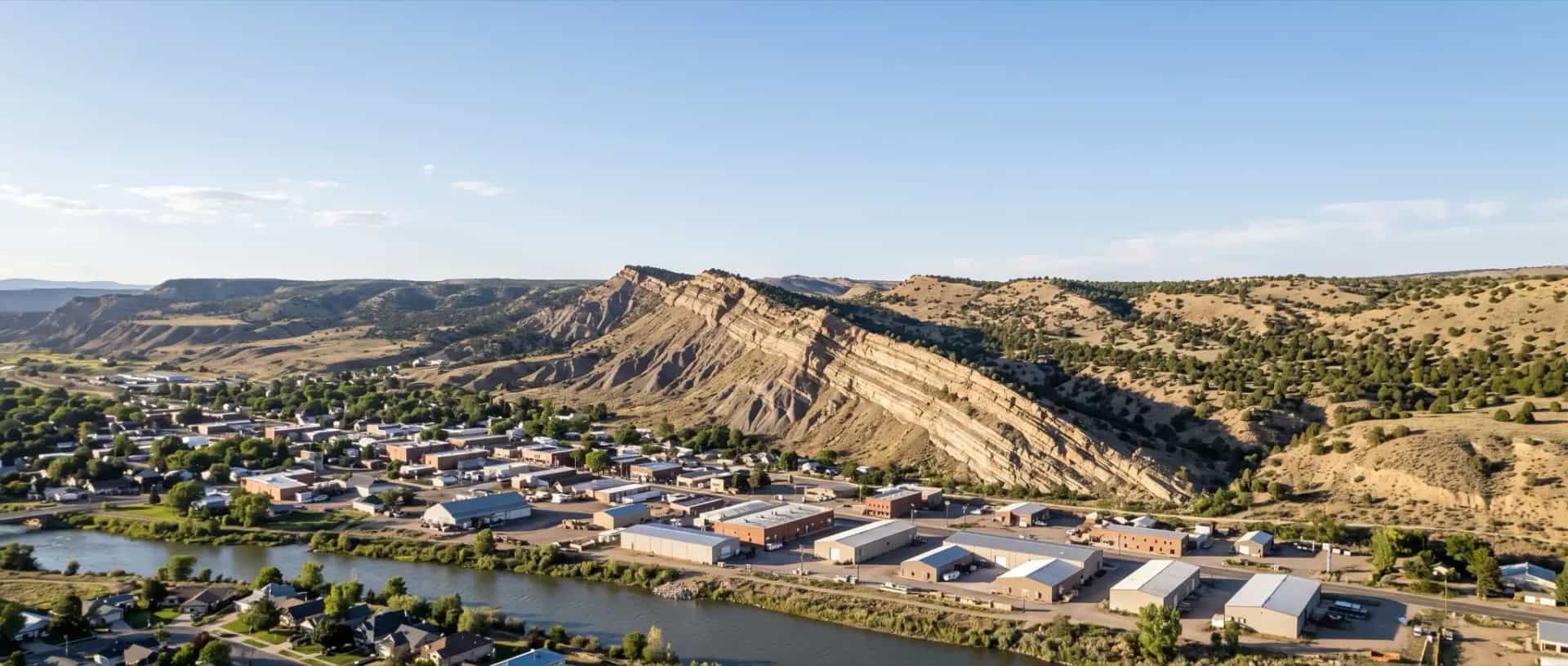
Rifle sits at about 5,300 feet where Rifle Creek meets the Colorado River, roughly 60 miles east of Grand Junction on I-70 and 30 miles west of Glenwood Springs. It is a genuine transition point: west toward Grand Junction the climate dries out and snow loads fall away, while east and north the terrain climbs into the Flat Tops and the Roaring Fork with heavier snow and stiffer requirements. Rifle's own numbers reflect that middle position, and they are meaningfully higher than the Grand Valley's.
The building stock reflects an energy-services economy layered onto an older ranching town: highway commercial and light industrial along the I-70 and Highway 13 corridors, a downtown core along Railroad Avenue and 3rd Street, and residential neighborhoods spreading north toward Rifle Gap. Low-slope membrane and steep-slope shingle work sit close together, and both run through the same permit and licensing process.
Roofing Codes and Permits in Rifle
Roofing work in Rifle is permitted and inspected by the City of Rifle Building Department (970-665-6461). Colorado has no statewide roofing code, so requirements are set jurisdiction by jurisdiction and genuinely differ between neighbouring towns. The details below are taken from the City of Rifle Building Department's published requirements.
Worth knowing in Rifle: Rifle licenses roofing as its own named specialty trade, and states that no permit will be issued to, and no work performed by, a contractor who has not first obtained that city license. It is one of the few jurisdictions in our service area where the contractor's credential is itself a permitting gate.
Commercial roofing code in Rifle
| Requirement | Requirement in Rifle |
|---|---|
| Adopted code | 2015 International Building Code |
| Energy code | 2009 International Energy Conservation Code |
| Current codes effective | April 1, 2018 for the 2015 code editions. The Colorado Wildfire Resiliency Code took effect here July 1, 2026. |
| When a permit is required | Reroofs are listed as permit-required work, and Rifle publishes no minimum area threshold, so a permit should be assumed on any reroof. Rifle also requires a city contractor license in the named Roofing specialty class before a permit will issue or any work is performed. |
| Ice barrier | Required. |
| Design wind speed | 120 mph ultimate design wind speed (90 mph allowable stress design). Not a special wind region; exposure category is determined by the design professional. |
| Design snow load | Ground snow load 47 psf with a 40 psf roof live load, raised from 40 psf in 2018. Uneven accumulation at valleys, parapets and roof offsets must be accounted for. |
| Frost depth | 36 inches |
Residential roofing code in Rifle
| Requirement | Requirement in Rifle |
|---|---|
| Adopted code | 2015 International Residential Code |
| Energy code | 2009 International Energy Conservation Code |
| Current codes effective | April 1, 2018 for the 2015 code editions. The Colorado Wildfire Resiliency Code took effect here July 1, 2026. |
| When a permit is required | Reroofs are listed as permit-required work, and Rifle publishes no minimum area threshold, so a permit should be assumed on any reroof. Rifle also requires a city contractor license in the named Roofing specialty class before a permit will issue or any work is performed. |
| Ice barrier | Required. |
| Design wind speed | 120 mph ultimate design wind speed (90 mph allowable stress design). Not a special wind region; exposure category is determined by the design professional. |
| Design snow load | Ground snow load 47 psf with a 40 psf roof live load, raised from 40 psf in 2018. Uneven accumulation at valleys, parapets and roof offsets must be accounted for. |
| Frost depth | 36 inches |
This is a summary to help you plan, not a compliance determination. The City of Rifle Building Department is the authority on what your specific roof requires, and we always confirm current requirements with them before we scope a job. Several Colorado jurisdictions changed their adopted codes during 2026, so we re-verify against each department's own published codes rather than working from memory. Source: City of Rifle Ordinance No. 2, Series of 2018 (2015 I-Codes and local amendments), Ordinance No. 08, Series of 2026 (adopting the CWRC), Rifle Municipal Code Chapter 18, and the City's Building Department and Residential Information pages. Last verified July 2026.
Wildfire code: what changes on a reroof
The 2025 Colorado Wildfire Resiliency Code applies inside mapped wildland-urban interface areas. Each jurisdiction declares and maps those areas itself and publishes the map, so whether a specific address falls inside one is checked against the local map. Where it applies, the rule that matters most on a reroof is the 25 percent threshold: where an existing roof is replaced, or 25 percent or more of the roof surface area is replaced, the entire roof covering must be brought up to the new-construction wildfire standard, unless the existing covering already complies.
The new-construction standard means roofs must have a covering or assembly classified Class A when tested to ASTM E108 or UL 790. Where the covering profile leaves a space above the deck, that space must resist flames and embers by noncombustible firestopping, an ASTM D3909 cap sheet over the combustible deck, or a listed Class A assembly. That last requirement catches tile and metal profiles, not just shingles, so it reaches commercial work as well as homes. We check the Rifle map before quoting, because it changes the scope rather than just the material.
For the full picture on storm-driven replacement, see our storm damage and insurance claim guidance.
Recorded Hail Around Rifle
No hail report has been filed under the Rifle name between 2017 through 2026, but that is a record-keeping fact rather than a measure of risk: the NOAA NCEI Storm Events Database logs storm reports against a named location, and small municipalities frequently have none of their own. Across Garfield County, Colorado, the same database recorded 3 reported hail events in that window, of which 3 produced stones of one inch or larger. The largest measured 1.5 inches on 29 July 2021, reported at Allen.
One inch is the size at which asphalt shingles typically start bruising, which is why that count matters more than the raw number of storms. Bruising fractures the mat under the granules and often leaves no obvious hole, so a roof can be functionally compromised while still looking intact from the driveway. That is what we look for on an inspection, and we photograph what we find so you have documentation before deciding anything.
These are county-wide figures from the NOAA NCEI Storm Events Database, 2017 through 2026, retrieved August 2026, not counts for Rifle specifically. They describe the hail exposure of the surrounding area. The real number of hail events over any given roof may be higher than the reported count.
The City License Requirement, and Why It Delays Jobs
Most Colorado jurisdictions will issue a roofing permit to any contractor who can pull one. Rifle will not. The city maintains its own contractor licensing scheme with roofing named explicitly as a specialty class, and it states plainly that no permit will be issued to, and no work performed by, an unlicensed contractor. Licenses expire December 31 each year regardless of when they were issued, and carrying workers' compensation and combined single-limit liability coverage is part of qualifying.
In practice this is where storm-chasing crews stall out in Rifle: the roof is sold, the permit is refused, and the homeowner is left holding a signed contract with nobody able to legally do the work. We hold the credentials the city requires and pull the permit ourselves, so the licensing step is handled before anything is torn off.
Roofing Services We Provide in Rifle
- Commercial roofing services - TPO, EPDM, metal, modified bitumen, and roof coatings for highway commercial, office, energy-services and light industrial buildings.
- Residential roofing - asphalt shingle (including Class 4 impact-resistant), metal, tile, and synthetic slate and shake, detailed with the ice barrier Rifle requires.
- Storm and insurance claim support - free damage documentation and adjuster coordination for both commercial property claims and residential homeowner claims, which are scoped and settled differently.
- Roof repair and full replacement - year-round, not just after storms.
Nearby Western Slope Communities We Serve
- Glenwood Springs
- Grand Junction
- Fruita
Frequently Asked Questions
Do you have an office in Rifle, CO?
Rifle is served by our Grand Junction office, about 60 miles east on I-70. Our crews work the Colorado River valley between Parachute and Glenwood Springs, and inspections are free with no obligation. Call (970) 877-7663 to schedule.
Which building code applies in Rifle, and who issues the permit?
The City of Rifle Building Department issues and inspects roofing permits directly under Chapter 18 of the Rifle Municipal Code. Rifle is a home rule city and its own permitting authority, not Garfield County. It is on the 2015 International Building Code and 2015 International Residential Code, effective April 1, 2018. Reach the building department at 970-665-6461.
Does my roofer need a Rifle city license?
Yes, and this is the requirement that catches out-of-town contractors most often. Rifle licenses roofing as its own named specialty trade, and the city states that no building permit will be issued to, and no work performed by, a contractor who has not first obtained that license. The credential is a permitting gate, not paperwork you can sort out later. Licenses run on a calendar year and expire December 31.
Do I need a permit to reroof in Rifle?
Assume yes. Rifle lists reroofs as permit-required work and publishes no minimum area threshold, and the code delegates the exempt-work list to a building official table that is not published online. Because there is no published exemption to rely on, we confirm scope with the building department rather than assuming a small repair falls below a line.
Is an ice barrier required on a Rifle roof?
Yes. Rifle's adopted design criteria table lists ice shield underlayment as required, and the residential code amendment points the residential path at the same criteria table as the commercial code, so the requirement reaches houses as well as commercial buildings. This is not universal in Colorado, which is exactly why it matters: neighbouring jurisdictions on the same code edition answer this question differently.
Does the Colorado wildfire code affect a Rifle reroof?
It can. Rifle adopted the Colorado Wildfire Resiliency Code effective July 1, 2026, and adopted it without a local mapping amendment, so the state's official wildfire hazard map governs which addresses are affected. Where it applies, replacing 25 percent or more of a roof triggers full compliance for the entire roof covering, which generally means a Class A assembly. We check the map for your specific address before quoting, because it changes the scope rather than just the material.
What snow load does a Rifle roof have to carry?
Rifle sets a ground snow load of 47 psf with a 40 psf roof live load, and requires that uneven accumulation at valleys, parapets and roof offsets be accounted for rather than treated as a flat uniform load. The ground figure was raised from 40 psf in 2018, so a roof designed under the older number is working to a lighter standard than the city now requires.
What commercial roofing do you do in Rifle?
Low-slope and flat commercial systems: TPO, EPDM, modified bitumen, metal, and fluid-applied roof coatings for highway commercial, office, energy-services and light industrial buildings along the I-70 corridor. Commercial work is reviewed under the International Building Code path rather than the residential code, and Rifle also requires engineer-stamped structural plans on commercial buildings.
What residential roofing do you do in Rifle?
Asphalt shingle including Class 4 impact-resistant products, metal, tile, and synthetic slate and shake, detailed with the required ice barrier and specified for the city's snow load. Residential work is reviewed under the International Residential Code path. Every recommendation follows a free inspection of the actual roof, not a guess from the driveway.
See all roofing FAQs. Grouped by topic: commercial and residential decisions, cost, insurance claims, storm response, warranties, and financing.
← Back to our Grand Junction office (2863 North Ave Unit 2, Grand Junction, CO 81501, (970) 877-7663)