Commercial Roofing Contractor provides commercial and residential roofing, roof replacement, and repair in Glenwood Springs, Colorado from our Grand Junction office. Glenwood Springs is one of the more demanding jurisdictions on the Western Slope to roof correctly: it permits through its own building department, requires three separate inspections on a reroof, writes snow-barrier spacing directly into its code, and classifies every address in the city at the highest wildfire tier, which means a minimum Class A roof on every job. Every inspection we do here is free and no-obligation.
Roofing Built for a Steep Mountain Valley
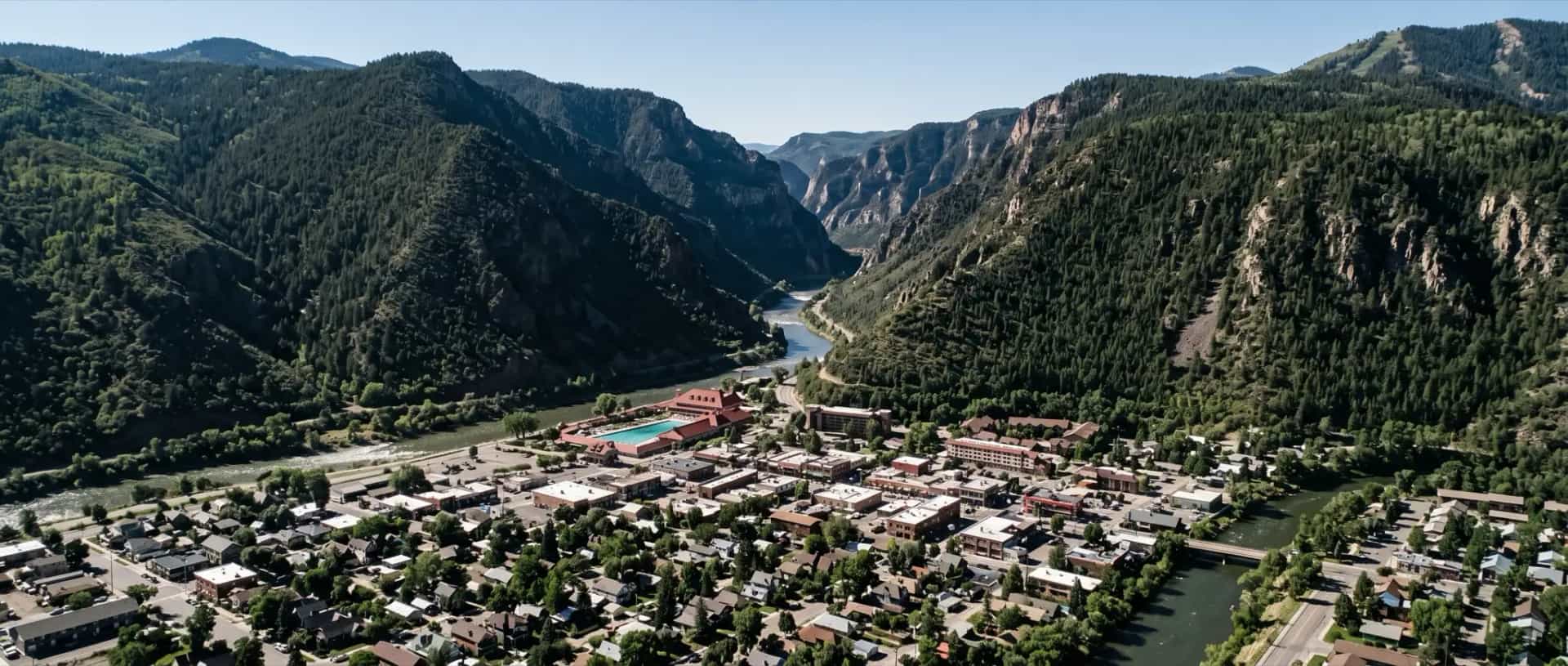
Glenwood Springs sits at about 5,760 feet where the Roaring Fork meets the Colorado River, roughly 90 miles east of Grand Junction through Glenwood Canyon. The town floor is narrow and the terrain climbs hard on both sides, and that geometry drives most of what makes roofing here different. Roofs hold real snow rather than the thin, fast-melting cover common further west, so shedding becomes a safety question: where snow lets go matters as much as whether the roof can carry it. Steep lots and tight setbacks put walkways, entries and utility meters directly beneath eaves. Buildings step up the hillsides quickly, so two properties a few streets apart can face meaningfully different design snow loads.
The building stock runs from the downtown commercial and hospitality core near the hot springs, through the Grand Avenue corridor, to residential neighborhoods climbing the valley walls, plus light industrial and highway-commercial buildings along I-70 and South Glen. Low-slope membrane and steep-slope work sit side by side within a few blocks, and the same wildfire requirement now applies to both.
Roofing Codes and Permits in Glenwood Springs
Roofing work in Glenwood Springs is permitted and inspected by the City of Glenwood Springs Building Department (970-384-6450). Colorado has no statewide roofing code, so requirements are set jurisdiction by jurisdiction and genuinely differ between neighbouring towns. The details below are taken from the City of Glenwood Springs Building Department's published requirements.
Worth knowing in Glenwood Springs: Glenwood Springs requires mechanical snow barriers, with the spacing written into the code: two staggered rows, the first no more than 24 inches from the eave and devices no more than 24 inches on center, on metal roofing and on any roof at 12:12 or steeper. Nowhere else in our service area prescribes snow retention this specifically, and it is a real cost and design factor on a steep mountain reroof.
Commercial roofing code in Glenwood Springs
| Requirement | Requirement in Glenwood Springs |
|---|---|
| Adopted code | 2021 International Building Code, as amended by Title 060 |
| Energy code | 2021 International Energy Conservation Code, as amended |
| Current codes effective | June 6, 2022 for the 2021 code editions. The Colorado Wildfire Resiliency Code took effect here July 1, 2026. |
| When a permit is required | A permit is required to replace more than 100 square feet of roofing, and reroofing always takes its own separate permit. Roofing does not appear on the list of work exempt from a permit. |
| Ice barrier | Required. |
| Overlay and recover | No local layer limit or recover amendment. In practice the constraint is the required decking inspection after tear-off, plus the wildfire code's rule that replacing 25 percent or more of the roof triggers full compliance for the entire roof covering. |
| Mid-roof inspection | Required, and it is one of three separate inspections: decking after tear-off, a mid-point dry-in, and a final. The city states that photographs do not count as an inspection, and that material may have to be removed at the installer's expense if an inspection is missed. |
| Design wind speed | 115 mph design wind speed. Not a special wind region, and no topographic effects factor. |
| Design snow load | Ground snow load 50 psf. The city also directs designers to the Structural Engineers Association of Colorado elevation formula, which it simplifies for Glenwood Springs and floors at 40 psf, so the governing figure depends on a site's elevation. |
| Frost depth | 36 inches |
Residential roofing code in Glenwood Springs
| Requirement | Requirement in Glenwood Springs |
|---|---|
| Adopted code | 2021 International Residential Code, as amended by Title 060 |
| Energy code | 2021 International Energy Conservation Code, as amended |
| Current codes effective | June 6, 2022 for the 2021 code editions. The Colorado Wildfire Resiliency Code took effect here July 1, 2026. |
| When a permit is required | A permit is required to replace more than 100 square feet of roofing, and reroofing always takes its own separate permit. Roofing does not appear on the list of work exempt from a permit. |
| Ice barrier | Required. |
| Overlay and recover | No local layer limit or recover amendment. In practice the constraint is the required decking inspection after tear-off, plus the wildfire code's rule that replacing 25 percent or more of the roof triggers full compliance for the entire roof covering. |
| Mid-roof inspection | Required, and it is one of three separate inspections: decking after tear-off, a mid-point dry-in, and a final. The city states that photographs do not count as an inspection, and that material may have to be removed at the installer's expense if an inspection is missed. |
| Design wind speed | 115 mph design wind speed. Not a special wind region, and no topographic effects factor. |
| Design snow load | Ground snow load 50 psf. The city also directs designers to the Structural Engineers Association of Colorado elevation formula, which it simplifies for Glenwood Springs and floors at 40 psf, so the governing figure depends on a site's elevation. |
| Frost depth | 36 inches |
This is a summary to help you plan, not a compliance determination. The City of Glenwood Springs Building Department is the authority on what your specific roof requires, and we always confirm current requirements with them before we scope a job. Several Colorado jurisdictions changed their adopted codes during 2026, so we re-verify against each department's own published codes rather than working from memory. Source: City of Glenwood Springs Commercial/Residential Roofing Permit Guide (revised 2026-07-29), Ordinance 2022-06 (Title 060), Ordinance 2024-12 (snow loads), and Ordinance 2026-04 (adopting the CWRC). Last verified July 2026.
Wildfire code: what changes on a reroof
The 2025 Colorado Wildfire Resiliency Code applies here, and Glenwood Springs is a specific case: the city classifies every address inside its limits as Class 2, the highest tier, so there is no map to check and no address that is exempt. Every new roof and every reroof must be a minimum Class A covering or Class A assembly.
The new-construction standard means roofs must have a covering or assembly classified Class A when tested to ASTM E108 or UL 790. Where the covering profile leaves a space above the deck, that space must resist flames and embers by noncombustible firestopping, an ASTM D3909 cap sheet over the combustible deck, or a listed Class A assembly. That last requirement catches tile and metal profiles, not just shingles, so it reaches commercial work as well as homes. Because this applies city-wide rather than by address, it changes the scope of essentially every reroof here, not just the material.
For the full picture on storm-driven replacement, see our storm damage and insurance claim guidance.
Recorded Hail Around Glenwood Springs
No hail report has been filed under the Glenwood Springs name between 2017 through 2026, but that is a record-keeping fact rather than a measure of risk: the NOAA NCEI Storm Events Database logs storm reports against a named location, and small municipalities frequently have none of their own. Across Garfield County, Colorado, the same database recorded 3 reported hail events in that window, of which 3 produced stones of one inch or larger. The largest measured 1.5 inches on 29 July 2021, reported at Allen.
One inch is the size at which asphalt shingles typically start bruising, which is why that count matters more than the raw number of storms. Bruising fractures the mat under the granules and often leaves no obvious hole, so a roof can be functionally compromised while still looking intact from the driveway. That is what we look for on an inspection, and we photograph what we find so you have documentation before deciding anything.
These are county-wide figures from the NOAA NCEI Storm Events Database, 2017 through 2026, retrieved August 2026, not counts for Glenwood Springs specifically. They describe the hail exposure of the surrounding area. The real number of hail events over any given roof may be higher than the reported count.
What the Three-Inspection Sequence Means for Your Schedule
Most Colorado jurisdictions close a reroof out on a final inspection, and some add a mid-roof. Glenwood Springs requires three: a decking inspection after tear-off, a mid-point dry-in, and a final. The practical effect is that the roof has to pause twice at defined points and wait for an inspector, which shapes crew scheduling, dry-in timing, and how much of the roof can safely be opened at once, especially in weather.
The city is also explicit that photographs do not substitute for an inspection, and that material may have to be removed at the responsible party's expense if an inspection is missed. We plan the sequence into the job from the start and pull the permit ourselves, because a torn-off roof waiting on a re-inspection is the expensive version of this problem.
Roofing Services We Provide in Glenwood Springs
- Commercial roofing services - TPO, EPDM, metal, modified bitumen, and roof coatings for downtown retail, hospitality, office and light industrial buildings, specified to meet the Class A requirement that applies city-wide.
- Residential roofing - asphalt shingle (including Class 4 impact-resistant), metal, tile, and synthetic slate and shake, detailed for snow retention where pitch or material requires it.
- Storm and insurance claim support - free damage documentation and adjuster coordination for both commercial property claims and residential homeowner claims, which are scoped and settled differently.
- Roof repair and full replacement - year-round, not just after storms.
Nearby Western Slope Communities We Serve
Frequently Asked Questions
Do you have an office in Glenwood Springs, CO?
Glenwood Springs is served by our Grand Junction office, about 90 miles west on I-70 through Glenwood Canyon. Our crews work the Colorado River valley and the Roaring Fork corridor, and inspections are free with no obligation. Call (970) 877-7663 to schedule.
Which building code applies in Glenwood Springs, and who issues the permit?
The City of Glenwood Springs Building Department issues and inspects roofing permits directly, under Title 060 of its municipal code. It is not Garfield County and not Mesa County. The city is on the 2021 International Building Code and 2021 International Residential Code as locally amended, effective June 6, 2022. Reach the building department at 970-384-6450.
Do I need a permit to reroof in Glenwood Springs?
Yes, for anything beyond a small repair. The city requires a permit to replace more than 100 square feet of roofing, and reroofing takes its own separate permit. Roofing is not on the list of work exempt from a permit. Confirm your specific scope with the building department, since the 100 square foot line is where a repair becomes permitted work.
How many inspections does a Glenwood Springs reroof need?
Three. A decking inspection after tear-off, a mid-point dry-in inspection, and a final inspection after completion. The city states plainly that photographs do not count as an inspection, and that material may have to be removed at the responsible party's expense if an inspection is missed. That sequencing is a real scheduling constraint and it is one of the more common ways an out-of-town contractor gets a job stalled here.
Are snow guards or snow retention required in Glenwood Springs?
Yes, and the spacing is written into the code rather than left to preference. Mechanical barriers are required on metal roofing and on any roof at 12:12 or steeper to protect walkways, and roofs must be designed so snow does not shed above or in front of gas and electric meters, egress doors, patios or decks. The code calls for at least two staggered rows, the first no more than 24 inches from the eave, with devices no more than 24 inches on center. This is the single most distinctive roofing requirement in our service area, and it is a genuine line item on a steep mountain reroof rather than an upsell.
Does the Colorado wildfire code affect a Glenwood Springs reroof?
Yes, and more than almost anywhere else. Glenwood Springs classifies every address inside its city limits as Class 2, the highest tier, so there is no map to check and no address that is exempt. Every new roof and every reroof must be at least a Class A covering or Class A assembly. Enforcement began July 1, 2026. That affects material selection on essentially every job in town, and it reaches metal and tile profiles, not just shingles.
What commercial roofing do you do in Glenwood Springs?
Low-slope and flat commercial systems: TPO, EPDM, modified bitumen, metal, and fluid-applied roof coatings for downtown retail, hospitality, office and light industrial buildings. Commercial work is reviewed under the 2021 International Building Code path rather than the residential code, and the Class A wildfire requirement applies to commercial roofs here as well. We handle the permit and the three-inspection sequence.
What residential roofing do you do in Glenwood Springs?
Asphalt shingle including Class 4 impact-resistant products, metal, tile, and synthetic slate and shake, all specified to meet the Class A requirement and detailed for snow retention where the pitch or material calls for it. Residential work is reviewed under the 2021 International Residential Code path. Every recommendation follows a free inspection of the actual roof.
What snow load does a Glenwood Springs roof have to carry?
The city sets a ground snow load of 50 psf, and also directs designers to the Structural Engineers Association of Colorado elevation formula, which it simplifies for Glenwood Springs with a floor of 40 psf. Because that formula is elevation-driven, the governing figure depends on where a building actually sits, and Glenwood Springs climbs steeply out of the valley floor. On any structural question we work from the engineer's number for the specific address, not a single citywide figure.
See all roofing FAQs. Grouped by topic: commercial and residential decisions, cost, insurance claims, storm response, warranties, and financing.
← Back to our Grand Junction office (2863 North Ave Unit 2, Grand Junction, CO 81501, (970) 877-7663)