
Commercial Roofing
Denver Commercial Roof Hail Storms of 2025 and 2026: Dates and Claim Timing
By Ryan Sanchez, Chief Operating Officer · Reviewed by the CRC team · November 18, 2026
- Commercial Roofing
- Hail Damage
- Insurance Claims
- Flat Roof
- Denver
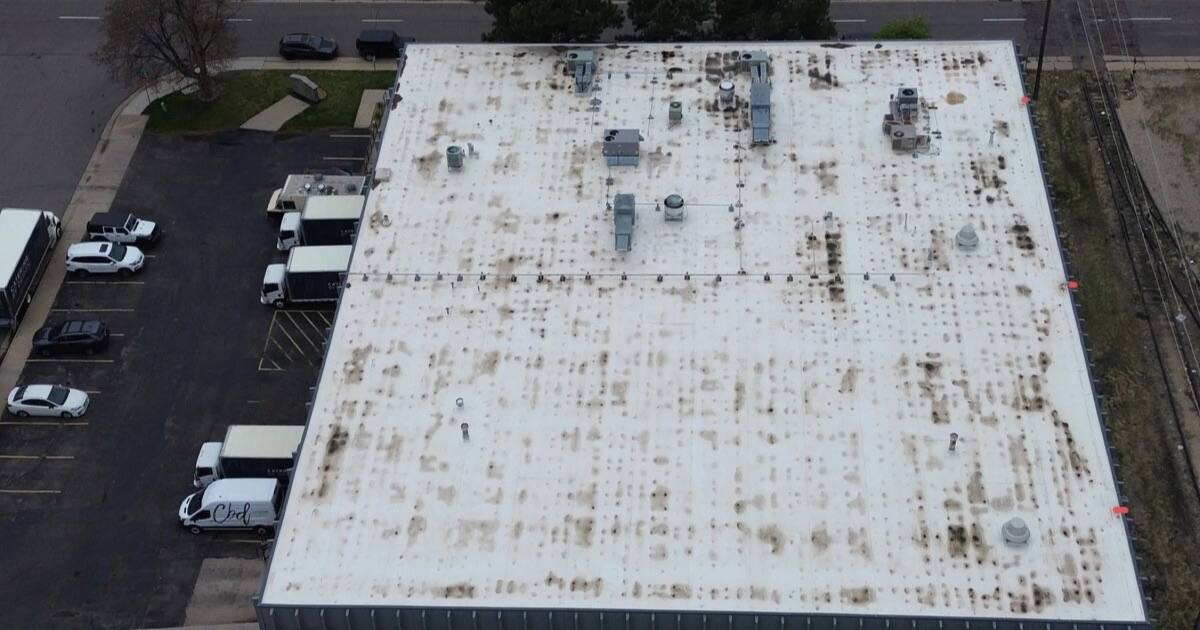
Short answer: NOAA storm records show 32 days in 2025 and 21 days so far in 2026 with hail of 1 inch or larger reported in the counties around Denver. On a flat or low-slope commercial roof the damage is usually invisible from the parking lot, and the deadline to report it is set by your commercial property policy, not by a Colorado statute.
Commercial roofs around Denver run from the southeast metro near Aurora and Centennial out to the farm, utility and industrial buildings on the Elbert County plains, with warehouses, offices, retail, churches, schools and apartment communities in between. Their owners, property managers and HOA boards can check, county by county, every day of 2025 and 2026 when stones of 1 inch or larger fell in Denver, Adams, Arapahoe, Jefferson, Douglas, Boulder, Broomfield, Weld, Larimer, El Paso and Elbert counties, the area our Denver office covers, and see how a commercial policy times a claim. Homeowners have a separate guide, Denver hail storm dates for homeowners, built on the same storm record under homeowner policy rules.
Why the list starts at 1 inch, and why a commercial roof can be hurt by less
Only days with hail of 1 inch or larger made the tables, and a commercial roof can still take damage below that line. Soft metal dents from about three quarters of an inch: drain strainers, scuppers, conductor heads, parapet caps and the condenser fins on rooftop units. On single-ply membrane such as TPO and EPDM, the threshold varies with the age of the membrane and the insulation underneath, and hail can fracture the reinforcing scrim without leaving a hole you can see. The detail for each roof type is in what size hail damages a roof.
2026 hail days of 1 inch or more around Denver
| Date | Largest hail reported | Reported near |
|---|---|---|
| September 22, 2026 (preliminary) | 1 inch | Colorado Springs |
| September 19, 2026 (preliminary) | 1.25 inches | Matheson |
| August 26, 2026 (preliminary) | 1.25 inches | Castle Pines, Arapahoe Park, Greenland, The Pinery, Foxfield |
| August 22, 2026 (preliminary) | 1.5 inches | Watkins, Masters, Brighton, Arapahoe Park, Fort Lupton |
| August 19, 2026 (preliminary) | 1.5 inches | Deer Trail, Agate, Kutch |
| August 15, 2026 (preliminary) | 1.75 inches | Foxfield, Rush |
| August 14, 2026 (preliminary) | 1 inch | Englewood |
| August 13, 2026 (preliminary) | 1.75 inches | Foxfield, Arapahoe Park, Centennial |
| July 31, 2026 | 1 inch | Truckton |
| July 28, 2026 | 1 inch | Lyons, Castle Rock |
| July 3, 2026 | 1.25 inches | Buckingham |
| July 2, 2026 | 1.25 inches | Johnstown |
| June 26, 2026 | 1 inch | Federal Heights, Northglenn, Broomfield |
| June 24, 2026 | 1.75 inches | Berthoud, Morrison, Bergen Park, Deer Trail, Littleton |
| June 23, 2026 | 2 inches | Cedar Point, Fondis, Simla, Kiowa |
| June 22, 2026 | 2 inches | Pawnee Buttes |
| June 20, 2026 | 2.25 inches | Pawnee Buttes, Grover, Stoneham, Lucerne |
| June 8, 2026 | 3.4 inches | Arvada, Golden, Edgewater, The Pinery, Simla |
| June 3, 2026 | 1 inch | Franktown |
| June 1, 2026 | 2 inches | Denver, Bennett, Buckley Space Force Base, Byers, Highlands Ranch |
| May 21, 2026 | 1.5 inches | Deer Trail |
Two days stand out for the metro. On June 1, 2026, hail of 1.75 inches was reported in Denver itself and near Buckley Space Force Base in Aurora, with stones up to 2 inches near Bennett. On June 8, 2026, storms dropped 1 inch and larger hail near Arvada, Golden and Edgewater on the west side, while the largest stone of the day, 3.4 inches, fell near Cedar Point on the Elbert County plains. In August, preliminary reports ran through the southeast metro near Foxfield and Centennial, and on August 22 a line of storms reported hail near Brighton, Watkins and Fort Lupton.
2025 hail days of 1 inch or more around Denver
| Date | Largest hail reported | Reported near |
|---|---|---|
| September 11, 2025 | 1.5 inches | Pawnee Buttes, Grover, Hereford |
| August 24, 2025 | 1 inch | Peterson Space Force Base |
| August 23, 2025 | 1.5 inches | Conifer, Bergen Park |
| August 14, 2025 | 1 inch | Matheson |
| August 10, 2025 | 1 inch | Niwot, Masters |
| August 9, 2025 | 3 inches | Cedar Point, Matheson, Calhan |
| August 1, 2025 | 1.25 inches | Hereford, Fort Lupton |
| July 31, 2025 | 1.5 inches | Garden City, Purcell, Nunn |
| July 24, 2025 | 1.25 inches | Greeley, Johnstown, Keenesburg |
| July 16, 2025 | 1.5 inches | Widefield, Fountain |
| July 14, 2025 | 1 inch | Kiowa, Calhan |
| July 11, 2025 | 2 inches | Grover, Rockport, Louisville, Stoneham |
| July 6, 2025 | 2 inches | Colorado Springs, Black Forest, Falcon, Manitou Springs, Widefield |
| July 4, 2025 | 1 inch | Air Force Academy |
| June 29, 2025 | 1 inch | Nunn, Glen Haven, Drake |
| June 25, 2025 | 1 inch | Firestone, Calhan |
| June 24, 2025 | 1 inch | The Pinery, Falcon |
| June 17, 2025 | 2.75 inches | Johnstown, Colorado Springs, Air Force Academy, Henderson, Eaton |
| June 15, 2025 | 1.75 inches | Colorado Springs, Peterson Space Force Base, Falcon, Manitou Springs, Schriever Space Force Base |
| June 14, 2025 | 1.75 inches | Black Forest, Air Force Academy, Manitou Springs, Colorado Springs, Peterson Space Force Base |
| June 8, 2025 | 1 inch | Monument |
| June 6, 2025 | 1 inch | Peterson Space Force Base |
| June 2, 2025 | 1.25 inches | Stoneham |
| May 28, 2025 | 1.5 inches | Peterson Space Force Base |
| May 27, 2025 | 1.5 inches | Peyton, New Raymer |
| May 24, 2025 | 2 inches | Palmer Lake, Peyton, Elbert, Elizabeth, Kiowa |
| May 23, 2025 | 2.5 inches | Stoneham, Pawnee Buttes |
| May 22, 2025 | 1 inch | Pawnee Buttes |
| May 18, 2025 | 1.5 inches | Arapahoe Park, Marshall |
| May 14, 2025 | 1.25 inches | Erie, Frederick |
| April 24, 2025 | 1 inch | Hudson, La Salle, Evans |
| April 23, 2025 | 2.5 inches | Fondis, Matheson, Monument, Cedar Point |
The broadest 2025 storm was June 17, 2025: hail of 1 inch or more reported in eight of these counties in one afternoon, from Colorado Springs north through Henderson and Eaton, with the largest stone, 2.75 inches, near Johnstown. On July 24, 2025, reports came in from Greeley, Johnstown and Keenesburg. Several of the largest 2025 stones, including 3 inches on August 9, fell on the open plains of Elbert and eastern El Paso counties, where farm, utility and industrial buildings are often the only roofs in the path.
A place missing from the list does not mean your building missed the storm
Every report in these tables was filed where a trained spotter, a member of the public or an automated station happened to be. Hail swaths are often miles wide, and a business park between two named towns can sit squarely inside one. If your building is near a reported place on one of these dates, treat that date as a possible date of loss until an inspection says otherwise.
What hail does to a commercial roof that you cannot see from the ground
On a house, a ground-level look at the gutters often tells you whether a storm was serious. On a flat commercial roof it rarely does. The damage that decides an insurance claim is on top and inside the roof assembly:
- Fractured membrane. A cracked scrim or a bruised seam that still looks intact and starts leaking after the next freeze and thaw.
- Cracked cover board. The rigid board under the membrane can crack from impacts that leave the surface looking fine, which lets the membrane flex and water travel.
- Drains and edge metal. Flattened drain strainers, dented scuppers and coping. Hail-crushed drainage belongs in the same insurance claim as the roof, and roof drainage that cannot carry water away shortens the life of whatever goes back on.
- Rooftop equipment. Dented condenser fins and housings on HVAC units, which are often the clearest proof of the storm date.
A membrane roof needs a walked inspection of the whole surface, sometimes with test cuts or a thermal imaging roof inspection, rather than a drone pass or a look from a ladder. On a two-building commercial TPO roof replacement in Denver's Northfield area, after an earlier storm in May 2024, the insurer's first assessment covered only a fraction of the damage. Opening the roof assembly showed the hail had cracked the cover board and let moisture in, and that evidence is what got both roofs rebuilt.
Is there a deadline to file a commercial hail insurance claim in Colorado?
Colorado has no single statute that sets a deadline for opening a commercial property insurance claim. The deadline is in your policy, usually written as a duty to give the carrier prompt notice of a loss, and the longer you wait, the harder it is to show that a given storm caused the damage rather than age or ordinary wear.
For homeowners, C.R.S. 10-4-110.8(12) stops a policy issued or renewed after January 1, 2014 from requiring suit in less time than the statute of limitations allows. Commercial property policies are governed by their own contract language instead, so the suit-limitation clause in your specific policy controls. Review it with your broker or attorney before assuming you have the same window a homeowner would. How we document and support a commercial claim is set out in our roof insurance claims guide.
How to find the deadline in a commercial property policy
- Start with the declarations page. It shows the wind and hail deductible, which on a commercial policy can be a percentage of each building's insured value rather than a flat amount, and whether the roof is covered at replacement cost or actual cash value.
- Find the duties after a loss. Commercial forms often put the notice requirement under a heading such as Duties in the Event of Loss or Damage. That is the clock for telling the carrier.
- Find the time limit to sue. Look for a heading such as Legal Action Against Us. On a commercial policy that clause sets its own period.
- Check for ordinance or law coverage. A replacement roof has to meet the code adopted today, which can add tear-off, insulation or edge work the old roof never had. Many commercial policies carry coverage for that, with limits that vary.
- Ask your broker in writing. Give them the storm date from the tables above and ask which deadlines apply to it. Keep the answer with your photos and leak log.
One point of arithmetic. The June 2025 storms above are now about 17 months old. If your building took damage on one of those dates and nobody has reported it, the notice clause in your policy is the first thing to read, because it decides whether that date is still open.
Evidence that ties damage to a storm date
Commercial insurance claims are bigger and slower than residential ones, with more roof to scope and often more than one building, so the paperwork does more of the work. Useful records include a leak log with dates and locations, photos of rooftop units and drains taken soon after the storm, interior ceiling stains with the date they appeared, and maintenance or inspection reports from before the storm that show what condition the roof was in. If several buildings on one property were hit on the same day, they belong under the same date of loss. For the step-by-step process from inspection to an approved scope, see hail inspection to insurance approval.
Not sure whether a storm damaged your building?
Our Denver office walks commercial roofs across these counties for free, photographs and marks what we find, and tells you plainly whether the damage supports a claim or is better handled as commercial roof repair outside of insurance. You can book a free roof inspection online. Our Grand Junction and Scottsbluff offices keep the same record for their areas in Grand Junction commercial hail and wind dates and Scottsbluff commercial hail dates.
Sources: NOAA National Centers for Environmental Information Storm Events Database (2025, and 2026 through July) and NOAA Storm Prediction Center local storm reports (2026 dates not yet in that database, marked preliminary), retrieved November 3, 2026. Counts include only hail of 1 inch or larger reported in the eleven counties named above.
Denver Commercial Hail Storm Date FAQs
Who reports the claim when a tenant occupies the building?
Whoever the policy names as the insured, which is usually the owner, though a lease can make the tenant responsible for reporting roof leaks or for the roof itself. Check the lease and the policy, agree who calls the carrier, and give them the same storm date so the claim is not opened twice.
Related Resources
Talk to the team nearest you: our Denver office for the Front Range, our Grand Junction office for the Western Slope, or our Scottsbluff office for the Nebraska Panhandle.