Commercial Roofing Contractor provides commercial and residential roofing, roof replacement, repair, and hail damage work in Boulder, Colorado from our Denver office. Boulder allows Class A roof assemblies only, on new and existing buildings alike, and bans wood roofing outright. It also runs the most demanding inspection regime in the metro. Every inspection we do in Boulder is free and no-obligation.
Roofing Against the Flatirons
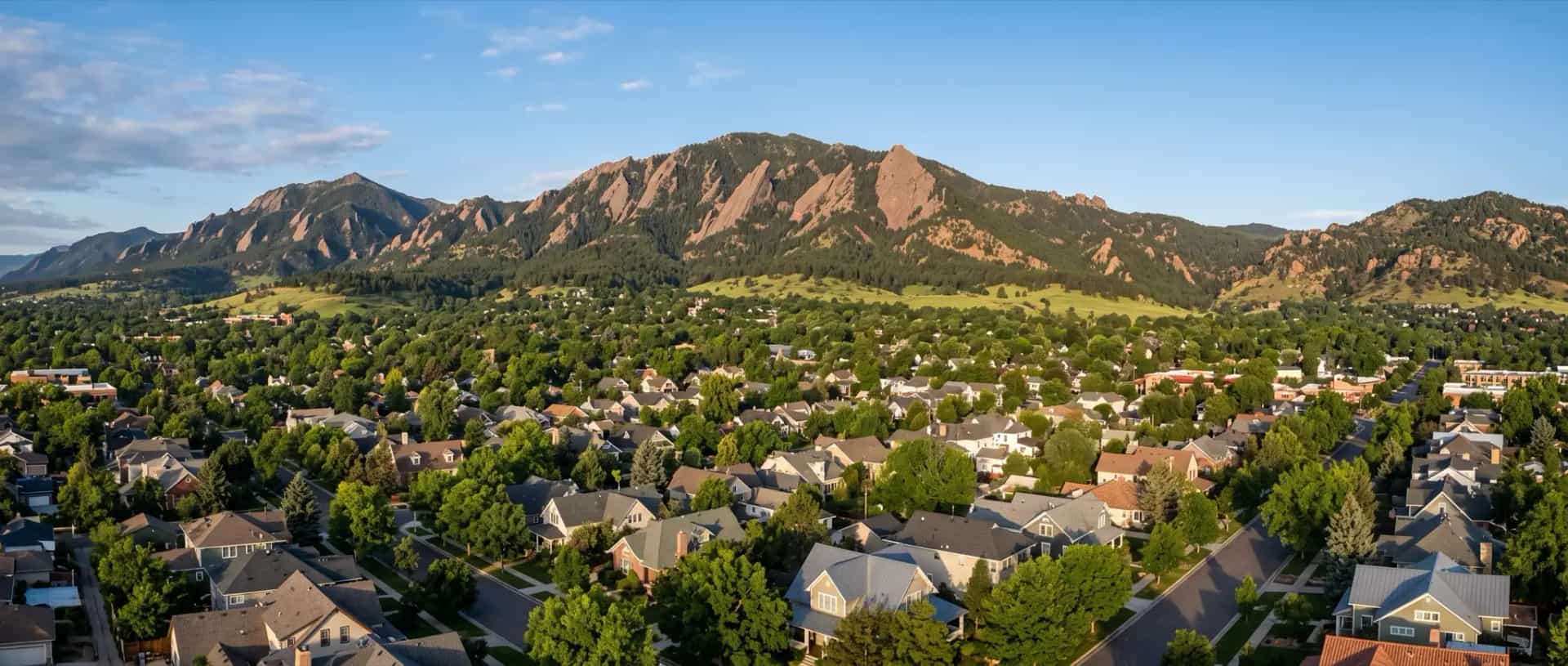
Boulder sits at roughly 5,430 feet where the plains run straight into the Flatirons, and that abrupt transition drives almost everything unusual about roofing here. Wind is the first factor: the city sets its design wind speed by zone rather than one number, and the dividing line is Broadway, with the western half designed to markedly higher speeds than the east because downslope and canyon winds accelerate as they come off the range. Fire is the second. Boulder banned wood roof coverings city-wide years before the state took an interest, with the deadline to remove existing wood roofs having passed in 2014, and it permits Class A assemblies only on any building new or existing. The Marshall Fire sharpened that thinking rather than starting it. The building stock spans the brick and stone of the older neighbourhoods and the University Hill area, the low-slope commercial and lab buildings along the Pearl Street and 28th Street corridors and out toward Gunbarrel, and newer construction climbing toward the foothills where wind zone and fire exposure both step up.
Recorded Hail in Boulder
Between 2017 through 2026 the NOAA NCEI Storm Events Database recorded 29 reported hail events in Boulder, of which 22 produced stones of one inch or larger. The largest on record measured 2 inches on 18 June 2018. The 18 June 2018 storm was exceptional rather than typical: it produced a run of reported stones over Boulder across roughly two hours, several of them at 1.75 inches before the 2 inch report.
One inch is the size at which asphalt shingles typically start bruising, which is why that count matters more than the raw number of storms. Bruising fractures the mat under the granules and often leaves no obvious hole, so a roof can be functionally compromised while still looking intact from the driveway. That is what we look for on an inspection, and we photograph what we find so you have documentation before deciding anything.
Figures are reported events from the NOAA NCEI Storm Events Database, 2017 through 2026, retrieved August 2026. NCEI records storm reports filed for a named location, so the real number of hail events over any given roof may be higher than the reported count.
Roofing Codes and Permits in Boulder
Roofing work in Boulder is permitted and inspected by the City of Boulder Planning and Development Services. Colorado has no statewide roofing code, so requirements are set jurisdiction by jurisdiction and genuinely differ between neighbouring towns. The details below are taken from the City of Boulder Planning and Development Services's published requirements.
Worth knowing in Boulder: Boulder allows Class A roof assemblies only, on any new or existing building, and prohibits wood shakes and wood shingles outright, including fire-retardant treated products. It is also the only jurisdiction we work in that requires a sealed letter from a qualified design professional at the mid-roof inspection, it licenses roofing as its own contractor class, and it writes its own energy code rather than adopting the IECC.
Commercial roofing code in Boulder
| Requirement | Requirement in Boulder |
|---|---|
| Adopted code | 2024 International Code Council suite with local amendments in Title 10 of the Boulder Revised Code |
| Energy code | 2024 City of Boulder Energy Conservation Code (CoBECC), effective December 1, 2024 |
| Current codes effective | August 1, 2025 |
| When a permit is required | There is no minimum area. Boulder's list of work exempt from a building permit contains no roofing exemption, so roofing work requires a permit. The 2026 fee schedule sets the roofing permit fee from the applicant's valuation rather than from any area threshold. |
| Ice barrier | Not required. Boulder amended the climatic and geographic design criteria for IRC Table R301.2(1) to set ice barrier underlayment to NO, so the requirement is switched off rather than reduced. |
| Overlay and recover | A pre-roof inspection is required for all roof overlays in Boulder, and photographs of core samples must be provided. Boulder has no local amendment to the reroofing sections, so the base code provisions govern the number of layers. |
| Mid-roof inspection | Triggered by any pitch under 4/12 or any roof type other than asphalt shingles. Class A assembly documentation is required, and photos are due by 2 p.m. on the inspection date. Low-slope membrane assemblies need either a full engineered design at permit application or a sealed deferred-design letter at mid-roof. |
| Design wind speed | Set by wind zone rather than a single figure. East of Broadway 140, 150 or 160 mph and west of Broadway 155, 165 or 175 mph, by risk category. These are the highest design wind speeds in our service area. |
| Design snow load | Ground snow load 40 psf |
Residential roofing code in Boulder
| Requirement | Requirement in Boulder |
|---|---|
| Adopted code | 2024 International Code Council suite with local amendments in Title 10 of the Boulder Revised Code |
| Energy code | 2024 City of Boulder Energy Conservation Code (CoBECC), effective December 1, 2024 |
| Current codes effective | August 1, 2025 |
| When a permit is required | There is no minimum area. Boulder's list of work exempt from a building permit contains no roofing exemption, so roofing work requires a permit. The 2026 fee schedule sets the roofing permit fee from the applicant's valuation rather than from any area threshold. |
| Ice barrier | Not required. Boulder amended the climatic and geographic design criteria for IRC Table R301.2(1) to set ice barrier underlayment to NO, so the requirement is switched off rather than reduced. |
| Overlay and recover | A pre-roof inspection is required for all roof overlays in Boulder, and photographs of core samples must be provided. Boulder has no local amendment to the reroofing sections, so the base code provisions govern the number of layers. |
| Mid-roof inspection | Triggered by any pitch under 4/12 or any roof type other than asphalt shingles. Class A assembly documentation is required, and photos are due by 2 p.m. on the inspection date. Low-slope membrane assemblies need either a full engineered design at permit application or a sealed deferred-design letter at mid-roof. |
| Design wind speed | Set by wind zone rather than a single figure. East of Broadway 140, 150 or 160 mph and west of Broadway 155, 165 or 175 mph, by risk category. These are the highest design wind speeds in our service area. |
| Design snow load | Ground snow load 40 psf |
This is a summary to help you plan, not a compliance determination. The City of Boulder Planning and Development Services is the authority on what your specific roof requires, and we always confirm current requirements with them before we scope a job. Several Colorado jurisdictions changed their adopted codes during 2026, so we re-verify against each department's own published codes rather than working from memory. Source: Boulder Revised Code Title 10 sections 10-5-2, 10-5-5 and 10-5.5-2 (codified on Municode), plus the City of Boulder Roof Inspection Guide and Building Codes and Regulations page (read the source document). Last verified July 2026.
Wildfire code: what changes on a reroof
The 2025 Colorado Wildfire Resiliency Code applies inside mapped wildland-urban interface areas. Each jurisdiction declares and maps those areas itself and publishes the map, so whether a specific address falls inside one is checked against the local map. Where it applies, the rule that matters most on a reroof is the 25 percent threshold: where an existing roof is replaced, or 25 percent or more of the roof surface area is replaced, the entire roof covering must be brought up to the new-construction wildfire standard, unless the existing covering already complies.
The new-construction standard means roofs must have a covering or assembly classified Class A when tested to ASTM E108 or UL 790. Where the covering profile leaves a space above the deck, that space must resist flames and embers by noncombustible firestopping, an ASTM D3909 cap sheet over the combustible deck, or a listed Class A assembly. That last requirement catches tile and metal profiles, not just shingles, so it reaches commercial work as well as homes. We check the Boulder map before quoting, because it changes the scope rather than just the material.
For the full picture on storm-driven replacement, see our storm damage and insurance claim guidance.
Roofing Services We Provide in Boulder
- Commercial roofing services - TPO, EPDM, metal, modified bitumen and roof coatings for retail, office and light industrial buildings, including low-slope drainage corrections.
- Residential roofing - asphalt shingle including Class 4 impact-resistant products, metal, tile, and synthetic slate and shake.
- Storm and insurance claim support - free damage documentation and adjuster coordination for both commercial property claims and residential homeowner claims, which are scoped and settled differently.
- Roof repair and full replacement - year-round, not only after storms.
Nearby Front Range Communities We Serve
Frequently Asked Questions
What roof coverings are actually allowed in Boulder?
Class A assemblies only, plus the narrow Class B exceptions the code names, and that applies to any new or existing building in the city. Boulder amended both the residential and commercial codes to require it. Practically, if a product is not Class A rated to UL 790 or ASTM E108, it is not going on a Boulder roof.
Can I put a wood shake or cedar shingle roof on in Boulder?
No. Boulder prohibits wood roof covering materials outright, and the ordinance is explicit that the ban includes wood products with fire retardant treatments of any kind. The deadline for removing existing wood roofs passed on 1 January 2014. If you have a wood roof left in Boulder, the replacement will be a different material.
Does Boulder require ice and water shield?
No. Boulder amended the climatic and geographic design criteria to set ice barrier underlayment to NO, so the requirement is switched off rather than reduced. That is worth knowing because Longmont, in the same county, does require it. The answer genuinely depends on which city issues your permit.
What wind speed does a Boulder roof have to be designed for?
It depends which side of Broadway you are on. East of Broadway the design speeds are 140, 150 or 160 mph by risk category. West of Broadway they are 155, 165 or 175 mph. Those are the highest design wind speeds anywhere in our service area, and they change fastener and edge-detail requirements substantially.
What is the sealed letter Boulder asks for at mid-roof?
Boulder requires a sealed letter from a qualified design professional at the mid-roof inspection, certifying that the installed roof assembly meets all applicable building codes and safety standards. It is triggered by any pitch under 4/12 or any roof type other than asphalt shingles, so most commercial low-slope work needs one. Class A assembly documentation is required at the same point, and photos are due by 2 p.m. on the inspection date.
Is there anything extra if I want to overlay rather than tear off?
Yes. Boulder requires a pre-roof inspection for all roof overlays, and photographs of core samples must be provided. We do not quote an overlay in Boulder without planning for that step. We will also confirm the permitted layer count with Planning and Development Services rather than assuming, because Boulder has no local amendment on that point and we would rather check than guess.
How much hail does Boulder actually get?
The NOAA NCEI Storm Events Database records 29 reported hail events in Boulder between 2017 and 2026, 22 of which produced stones of one inch or larger. The largest on record was 2 inches on 18 June 2018, a storm that produced a run of reported stones over the city across roughly two hours.
See all roofing FAQs. Grouped by topic: commercial and residential decisions, cost, insurance claims, storm response, warranties, and financing.
← Back to our Denver office (5300 Broadway, Denver, CO 80216, (720) 893-7663)