Commercial Roofing Contractor provides commercial and residential roofing, roof replacement, repair, and hail damage work in Loveland, Colorado from our Denver office. Loveland requires Class 4 impact-resistant shingles once a replacement reaches 50 percent of the roof, and closing a permit there takes a signed affidavit as well as an inspection. Every inspection we do in Loveland is free and no-obligation.
Roofing Between the Foothills and the Plains
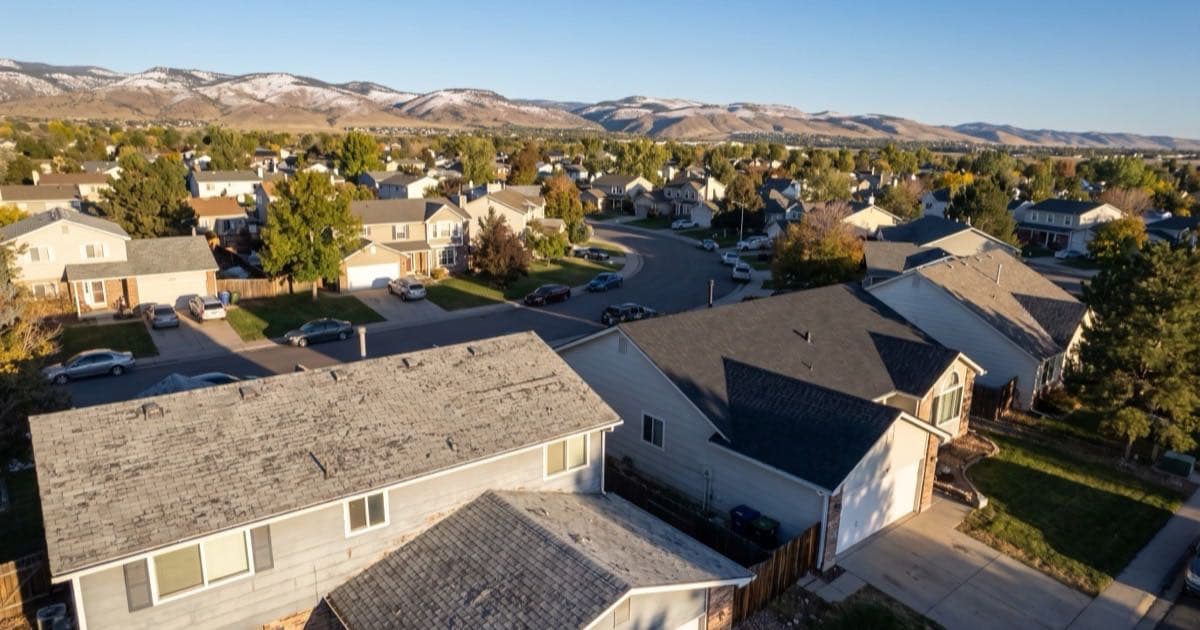
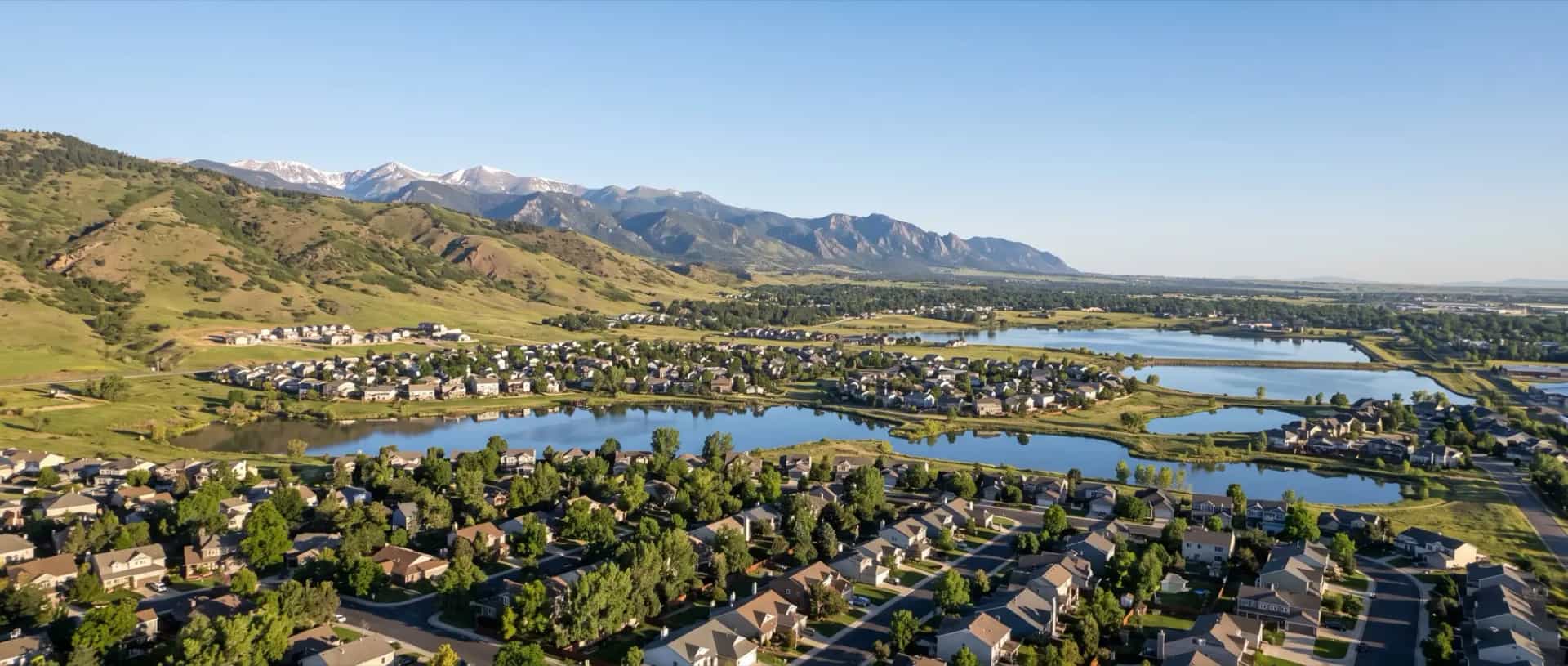
Loveland sits at roughly 4,980 feet where the Big Thompson leaves its canyon and spreads onto the plains, with the foothills close enough west of town to change both the wind and the fire picture within a few miles. The city designs to a 130 mph three-second gust and publishes its own Front Range gust map, and it draws its own fire line as well: a metes-and-bounds boundary west of which reroofing half a roof or more triggers a Class B covering, with Class A required inside the Loveland Fire Rescue Authority wildland-urban interface area. That is a local overlay on top of the statewide wildfire code rather than a restatement of it. The building stock runs from the older grid around Fourth Street and the downtown core, through the residential neighbourhoods that fill the ground between Highway 34 and the lake, out to the low-slope commercial and light industrial buildings along the Crossroads and I-25 corridor.
Recorded Hail in Loveland
Between 2017 through 2026 the NOAA NCEI Storm Events Database recorded 13 reported hail events in Loveland, of which 11 produced stones of one inch or larger. The largest on record measured 1.75 inches on 4 July 2018. Loveland has recorded 1.75 inch stones three separate times in the window, on 4 July 2018, 5 July 2019 and 5 August 2023, so its worst case is a recurring size rather than a one-off.
One inch is the size at which asphalt shingles typically start bruising, which is why that count matters more than the raw number of storms. Bruising fractures the mat under the granules and often leaves no obvious hole, so a roof can be functionally compromised while still looking intact from the driveway. That is what we look for on an inspection, and we photograph what we find so you have documentation before deciding anything.
Figures are reported events from the NOAA NCEI Storm Events Database, 2017 through 2026, retrieved August 2026. NCEI records storm reports filed for a named location, so the real number of hail events over any given roof may be higher than the reported count.
Roofing Codes and Permits in Loveland
Roofing work in Loveland is permitted and inspected by the City of Loveland Building Division (970-962-2181). Colorado has no statewide roofing code, so requirements are set jurisdiction by jurisdiction and genuinely differ between neighbouring towns. The details below are taken from the City of Loveland Building Division's published requirements.
Worth knowing in Loveland: Loveland requires Class 4 impact-resistant shingles meeting UL 2218 whenever 50 percent or more of a roof is replaced, a requirement no other jurisdiction in our service area imposes. It also designs to a 130 mph 3-second gust, and closing a permit takes three separate calls: final roof, roofing affidavit, and permit completion.
Commercial roofing code in Loveland
| Requirement | Requirement in Loveland |
|---|---|
| Adopted code | 2024 International Codes with local amendments |
| Current codes effective | July 1, 2026 |
| When a permit is required | Tiered by how much of the roof is involved. Under 100 square feet needs no permit and may be repaired like for like. Above that and up to 49 percent needs a permit and may still be a like-for-like repair. At 50 percent or more it becomes a full tear off and replacement. Repairs are not allowed at all where the roof already carries two or more layers, regardless of area. |
| Ice barrier | Required at all roof eaves, extending upslope to at least 24 inches beyond the interior edge of the exterior wall, and at least 36 inches upslope from the eave edge on roofs at 8:12 or steeper. Applied over the required metal drip edge. |
| Overlay and recover | Replacement means removal of existing layers down to the roof deck. Recover is not allowed where the existing roof is water soaked or deteriorating, where two or more layers exist, or where the covering is wood shake, slate, clay, cement or asbestos tile. An adhered ice barrier membrane may remain and be covered. |
| Mid-roof inspection | Required on every reroof, but documented by the contractor with photographs rather than a site visit: the city states inspectors will not attend for this verification. Photos must show sheathing replacement before and after, completed underlayment, the ice barrier with a measurement, valley and wall flashings, and the nailing pattern. |
| Design wind speed | 130 mph, 3-second gust, exposure C |
| Design snow load | Ground snow load 35 psf, per the Colorado Design Snow Loads published by the Structural Engineers Association of Colorado. Roof snow load is determined from ASCE 7-16 Chapter 7, and the final design roof snow load may never be less than a uniformly distributed 30 psf. |
| Frost depth | 30 inches |
Residential roofing code in Loveland
| Requirement | Requirement in Loveland |
|---|---|
| Adopted code | 2024 International Codes with local amendments |
| Current codes effective | July 1, 2026 |
| When a permit is required | Tiered by how much of the roof is involved. Under 100 square feet needs no permit and may be repaired like for like. Above that and up to 49 percent needs a permit and may still be a like-for-like repair. At 50 percent or more it becomes a full tear off and replacement. Repairs are not allowed at all where the roof already carries two or more layers, regardless of area. |
| Ice barrier | Required at all roof eaves, extending upslope to at least 24 inches beyond the interior edge of the exterior wall, and at least 36 inches upslope from the eave edge on roofs at 8:12 or steeper. Applied over the required metal drip edge. |
| Overlay and recover | Replacement means removal of existing layers down to the roof deck. Recover is not allowed where the existing roof is water soaked or deteriorating, where two or more layers exist, or where the covering is wood shake, slate, clay, cement or asbestos tile. An adhered ice barrier membrane may remain and be covered. |
| Mid-roof inspection | Required on every reroof, but documented by the contractor with photographs rather than a site visit: the city states inspectors will not attend for this verification. Photos must show sheathing replacement before and after, completed underlayment, the ice barrier with a measurement, valley and wall flashings, and the nailing pattern. |
| Design wind speed | 130 mph, 3-second gust, exposure C |
| Design snow load | Ground snow load 35 psf, per the Colorado Design Snow Loads published by the Structural Engineers Association of Colorado. Roof snow load is determined from ASCE 7-16 Chapter 7, and the final design roof snow load may never be less than a uniformly distributed 30 psf. |
| Frost depth | 30 inches |
This is a summary to help you plan, not a compliance determination. The City of Loveland Building Division is the authority on what your specific roof requires, and we always confirm current requirements with them before we scope a job. Several Colorado jurisdictions changed their adopted codes during 2026, so we re-verify against each department's own published codes rather than working from memory. Source: City of Loveland Ordinances 6808 (IBC) and 6809 (IRC), adopted 2 June 2026 and effective 16 June 2026, plus the Building Division Roofing Requirements packet (2024 IRC) and the Roofing Affidavit form (read the source document). Last verified July 2026.
Wildfire code: what changes on a reroof
The 2025 Colorado Wildfire Resiliency Code applies inside mapped wildland-urban interface areas. Each jurisdiction declares and maps those areas itself and publishes the map, so whether a specific address falls inside one is checked against the local map. Where it applies, the rule that matters most on a reroof is the 25 percent threshold: where an existing roof is replaced, or 25 percent or more of the roof surface area is replaced, the entire roof covering must be brought up to the new-construction wildfire standard, unless the existing covering already complies.
The new-construction standard means roofs must have a covering or assembly classified Class A when tested to ASTM E108 or UL 790. Where the covering profile leaves a space above the deck, that space must resist flames and embers by noncombustible firestopping, an ASTM D3909 cap sheet over the combustible deck, or a listed Class A assembly. That last requirement catches tile and metal profiles, not just shingles, so it reaches commercial work as well as homes. We check the Loveland map before quoting, because it changes the scope rather than just the material.
For the full picture on storm-driven replacement, see our storm damage and insurance claim guidance.
Roofing Services We Provide in Loveland
- Commercial roofing services - TPO, EPDM, metal, modified bitumen and roof coatings for retail, office and light industrial buildings, including low-slope drainage corrections.
- Residential roofing - asphalt shingle including Class 4 impact-resistant products, metal, tile, and synthetic slate and shake.
- Storm and insurance claim support - free damage documentation and adjuster coordination for both commercial property claims and residential homeowner claims, which are scoped and settled differently.
- Roof repair and full replacement - year-round, not only after storms.
Nearby Front Range Communities We Serve
Frequently Asked Questions
When does Loveland require Class 4 impact-resistant shingles?
Once you replace 50 percent or more of the roof. Loveland runs a tiered rule: under 100 square feet needs no permit and can be repaired like for like; above that and up to 49 percent needs a permit and can still be like for like; at 50 percent or more it becomes a full tear off and Class 4 shingles meeting UL 2218 are required. The Class 4 requirement has been in force since 1 June 2022.
What is the Roofing Affidavit and who signs it?
It is a one-page City of Loveland form signed by the contractor or by the homeowner doing the work. It certifies that the installation conforms to the manufacturer's requirements for the site ultimate design wind speed, printed on the form as 130 mph three-second gust, and it captures the covering type and class, the ASTM classification, fastener size type and count, and the underlayment used. It is emailed with a single PDF of date-stamped photos a day before the final inspection.
How many inspections does a Loveland roof permit need?
Three separate call-ins: Final Roof, Roofing Affidavit, and Permit Completion. Missing any one leaves the permit open. It is a genuine difference from most Front Range jurisdictions, where a single final closes the job.
Does Loveland send an inspector for the mid-roof?
No, and this is unusual. Loveland requires the mid-roof to be documented by the contractor with photographs and states plainly that city inspectors will not visit the site for that verification. The photos have to show sheathing replacement before and after, the completed underlayment, the ice barrier with a measurement proving two feet inside the exterior wall, valley and wall flashings, and the nailing pattern. A crew that does not photograph as it works cannot close the permit.
Does Loveland require ice and water shield?
Yes. It is required at all roof eaves, starting at the low eave edge and extending upslope at least 24 inches beyond the interior edge of the exterior wall, with at least 36 inches upslope on roofs at 8:12 or steeper, applied over the required metal drip edge.
Can I roof over the existing roof in Loveland?
Generally no. Replacement means removing existing layers down to the roof deck. Recover is not allowed where the existing roof is water soaked or deteriorating, where two or more layers already exist, or where the covering is wood shake, slate, clay, cement or asbestos tile. Repairs are not allowed at all where two or more layers exist, regardless of how small the area is. An adhered ice barrier membrane is the one thing permitted to remain.
How much hail does Loveland actually get?
The NOAA NCEI Storm Events Database records 13 reported hail events in Loveland between 2017 and 2026, 11 of which produced stones of one inch or larger. The largest on record was 1.75 inches, and Loveland has recorded that size three separate times, on 4 July 2018, 5 July 2019 and 5 August 2023, so its worst case is a recurring size rather than a single outlier.
See all roofing FAQs. Grouped by topic: commercial and residential decisions, cost, insurance claims, storm response, warranties, and financing.
← Back to our Denver office (5300 Broadway, Denver, CO 80216, (720) 893-7663)