
Residential Roofing
Why Scottsbluff Roofs Fail
By Chris Sanchez, Commercial Roofing Contractor · August 9, 2026
- Hail Damage
- Roof Inspection
- Homeowner Guide
- Nebraska
- Scottsbluff
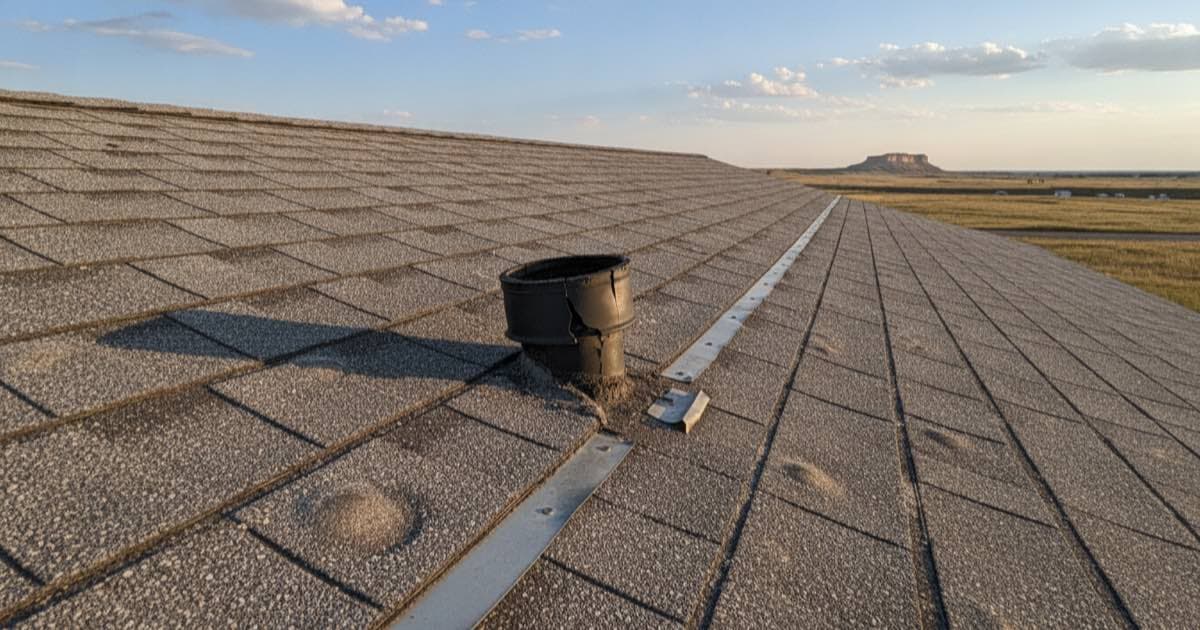
Short answer: not the way Colorado roofs fail. Scotts Bluff County has recorded no ice storm since 1996, so ice dams are rarely the culprit here. What ages a Scottsbluff roof is hail, roughly 174 freeze-thaw days a year working on flashings and pipe boots, and wind. The local code answers each of those differently.
Most roofing advice a Scottsbluff homeowner finds online was written for somewhere else. A lot of it was written for the Colorado Front Range, 3 hours south, and the advice that travels worst is the advice about ice. If you have been told your roof needs protecting from ice dams, the climate record for your own county says otherwise, and the money is better spent on what actually breaks roofs here.
The failure mode Scottsbluff mostly does not have
Ice damming needs a roof to hold snow long enough for melt water to refreeze at a cold eave. That requires a persistent snowpack on the roof, and this climate does not reliably build one. NOAA's storm database records no ice storm in Scotts Bluff County across its entire period of record since 1996. Only 1 has ever been logged anywhere in the 11 Panhandle counties, while Nebraska as a whole has recorded 288. Freezing precipitation is measured at the Scottsbluff airport on roughly 2 days a year.
That is also the likeliest reason the city has never designated itself in the residential code's climatic criteria table, which is what would switch an ice barrier requirement on. The table was left blank. So the question of whether your roof needs an ice barrier is not settled by the code table at all, which is covered further down.
Freeze-thaw is the one that actually ages your roof
What the area gets instead of ice storms is cycling. Around 174 days a year drop below freezing, but only 27 stay there. That ratio is the whole story: the temperature crosses the freezing point and comes back, over and over, every winter.
Each crossing moves every material on your roof a little. Metal flashing expands and contracts against shingle and masonry that move at a different rate. Sealant at a chimney or a wall termination is worked loose. A pipe boot, the rubber collar sealing the plumbing vent where it passes through the roof, is the classic casualty: the rubber stiffens, then splits, and the roof leaks around a penetration rather than through the field. None of that is dramatic and none of it shows from the ground, which is why it usually surfaces as a ceiling stain years after the shingles were fine.
The practical consequence is that on a Scottsbluff roof the details fail before the field does. An inspection that only counts shingle damage misses most of what is actually happening up there.
Hail is the loud one
Hail is the dominant failure mode here, and the local record is not marginal. Filtering NOAA's National Centers for Environmental Information storm events database to the towns we serve, from 2017 through 2026:
- Gering reported 21 hail events, and every single one reached 1 inch or larger. The 2 inch size has happened twice, on 16 August 2019 and 19 July 2020.
- Bayard recorded a 4 inch stone on 23 June 2023, the largest in our entire service area, Colorado included. It did not come alone: a 3.25 inch report was logged 1 minute earlier in the same storm.
- Minatare reported 16 events and all 16 reached 1 inch or larger, which is a remarkable concentration for a town that size.
- Bridgeport reported 11 events, all of them 1 inch or larger, and took 2.25 inch hail again on 22 June 2025, so the large sizes here are recent rather than historical.
- Morrill and Mitchell reported 9 and 8 events respectively, with largest stones of 2.75 and 1.75 inches.
The 23 June 2023 storm is worth understanding as one event rather than three. It produced the largest stone on record for Bayard, Minatare and Morrill within about 11 minutes end to end, which is a single supercell tracking across the Panhandle. If you own property in more than one of those towns, one storm date can sit behind all of it.
One honest caveat on the numbers: storm reports are filed under individual town names, and there is no separate entry for Scottsbluff itself in that dataset. That is a quirk of how reports are logged, not evidence that hail skips the city. Neighbouring Terrytown has no entry either, and it sits between Scottsbluff and Gering, which record plenty.
Wind, and what the code assumes
Wind does two things to a roof here. It drives hail in at an angle, which puts far more energy into a strike than the same stone falling straight down, and it works at edges and ridges where a shingle is already held by nothing but its sealant strip.
On design figures, be careful what you are told. Gering, immediately next door, publishes an ultimate design wind speed of 115 mph and states it is not a special wind region and not a windborne debris zone. Scottsbluff does not publish a design wind speed of its own. We do not assume Gering's figure carries across the river, and neither should a contractor quoting you: exposure is assessed per site, and the two cities are separate authorities with genuinely different roofing requirements.
What the local code does about all this
Scottsbluff adopted the 2018 International Building Code and the 2018 International Residential Code by ordinance, effective January 2020. Three provisions change what a reroof costs here.
Full tear-off, always. Section 1511.3 requires a roof replacement to remove all existing layers down to the decking, and Section 1511.3.1.1 does not permit a recover where the roof already carries 2 or more applications of any covering. Layered roofs cannot be built up further, which also keeps dead load off the structure. If a quote proposes going over the existing roof, that is the thing to question first.
R-30 on low-slope commercial. The 2018 International Energy Conservation Code sets an R-30 insulation value for this climate zone, and it is adopted separately precisely because the energy chapters of the building and residential codes are excluded. Bringing an older commercial roof up to R-30 usually means adding insulation thickness rather than simply replacing the membrane, and that changes edge details, flashing heights and drainage. Scope it before a budget is set rather than discovering it at permit review.
Ice barrier by manufacturer, not by table. Because the climatic criteria table was never filled in, the requirement is not switched on that way. But the code separately requires roofing to be installed to the manufacturer's instructions, and where your shingle manufacturer requires an ice barrier at the eaves as a warranty condition, the code requires it too. That is usually what decides it on a Scottsbluff roof.
One more difference worth knowing if you are comparing quotes across the river: Scottsbluff closes a reroof out on a final inspection, with no mid-roof or in-progress roofing inspection in its published sequence. Gering requires 3 separate roofing inspections plus photographs. Same metro, different oversight.
This is a summary to help you plan, not a compliance determination. The City of Scottsbluff Development Services is the authority on what your specific roof requires, and we always confirm current requirements with them before we scope a job. Several Colorado jurisdictions changed their adopted codes during 2026, so we re-verify against each department's own published codes rather than working from memory. Source: Scottsbluff Code of Ordinances Article 4-1 (sections 4-1-2, 4-1-10 and 4-1-10.1), the City's published Scottsbluff and Terrytown Roofing Requirements sheet, NOAA National Centers for Environmental Information storm and climate records for Scotts Bluff County, and re-roofing and energy requirements confirmed by City of Scottsbluff Development Services. Last verified July 2026.
The local gap nobody mentions
Scottsbluff does not license roofing contractors. Registration is mandatory and it is unlawful to work in the city without it, which sounds like a safeguard and is not one. The city states plainly that anyone seeking to register will be allowed to, that the information is supplied by the contractor, and that the city does not verify it. Liability insurance is expressly not required in order to register.
Registration is therefore a filing, not a vetting. After a big hail event, when out-of-area crews arrive, that distinction is the one that costs people money. Ask for the insurance certificate directly and confirm it with the insurer, rather than treating a registration number as evidence of anything.
What this means for your roof
If you own property in Scottsbluff or the surrounding towns, the practical order is: assume hail is the thing most likely to end your roof, assume freeze-thaw is quietly ending your flashings and pipe boots in the meantime, and treat ice-dam advice written for the mountains as somebody else's problem. Budget for a full tear-off rather than a recover, and if the building is commercial and low slope, find out early whether R-30 applies to your scope.
Our Scottsbluff office has roofed the Panhandle since 2001, so we scope from the local code and the local record rather than from a template. If a storm has already come through and you are dealing with a carrier, the Nebraska storm damage claims guide covers your rights under Nebraska law, which differ from Colorado's in ways that matter.
Frequently Asked Questions
Do Scottsbluff roofs get ice dams?
Rarely, and the climate record is the reason. NOAA's storm database records no ice storm in Scotts Bluff County across its entire period of record since 1996, and only 1 has ever been logged anywhere in the 11 Panhandle counties, against 288 for Nebraska as a whole. Freezing precipitation is measured at the Scottsbluff airport on roughly 2 days a year. Ice damming needs a persistent roof snowpack that this climate does not build. What the area gets instead is hard freeze-thaw cycling, which damages a roof in a different way.
Does the code require an ice barrier on a Scottsbluff roof?
There is no simple yes or no, and anyone who gives you one is guessing. The residential code makes an ice barrier depend on a local designation in its climatic criteria table, and Scottsbluff has never filled that table in, so it is not switched on that way. What does still apply is the requirement to install roofing to the manufacturer's instructions. Where your shingle manufacturer requires an ice barrier at the eaves, and many do as a condition of the warranty, the code requires it too. That is usually what decides the question here, so we scope from the manufacturer's specification and confirm with the department.
How much hail does the Scottsbluff area actually get?
Enough that it is the dominant failure mode. In NOAA's storm database from 2017 through 2026, every one of Gering's 21 reported hail events reached 1 inch or larger, and 2 inch hail fell twice. Bayard recorded a 4 inch stone on 23 June 2023, the largest in our entire service area including Colorado. All 16 of Minatare's reported events reached 1 inch or larger, as did all 11 of Bridgeport's, which took 2.25 inch hail again on 22 June 2025. Reports file under individual town names, so there is no separate count for Scottsbluff itself.
Can I put a new roof over my old one in Scottsbluff?
No. Section 1511.3 requires a roof replacement to remove all existing layers of roof covering down to the decking, and Section 1511.3.1.1 does not permit a recover where the roof already carries 2 or more applications of any type of covering. The practical effect is that layered roofs cannot be built up further, which also keeps accumulated dead load off the structure. Budget for a full tear-off.
Does a Scottsbluff reroof need a permit?
Yes, every time. Scottsbluff lists roofing explicitly among the work requiring a permit, and there is no square-footage or dollar threshold below which a reroof is exempt, because the city excluded the model codes' work-exempt-from-permit sections when it adopted them. Replacing gutters is on the short list of work that does not need one. A local quirk worth knowing: no building permit is issued until an application for a solid waste container has also been submitted, so the dumpster is part of the permit process rather than an afterthought.
Is a roofing contractor in Scottsbluff licensed?
Not licensed, registered, and the difference matters. Scottsbluff does not license contractors. Registration is mandatory and it is unlawful to work in the city without it, but the city states plainly that anyone seeking to register will be allowed to, that the information is supplied by the contractor, and that the city does not verify it. Liability insurance is expressly not required to register. Registration is a filing, not a vetting, so check a contractor's insurance certificate yourself rather than treating registration as proof of anything.

Talk to the team nearest you: our Denver office, our Grand Junction office, or our Scottsbluff office.