
Residential Roofing
Scottsbluff Wind and Hail Deductibles Explained
By Ryan Sanchez, Commercial Roofing Contractor · August 9, 2026
- Insurance Claims
- Hail Damage
- Homeowner Guide
- Nebraska
- Scottsbluff
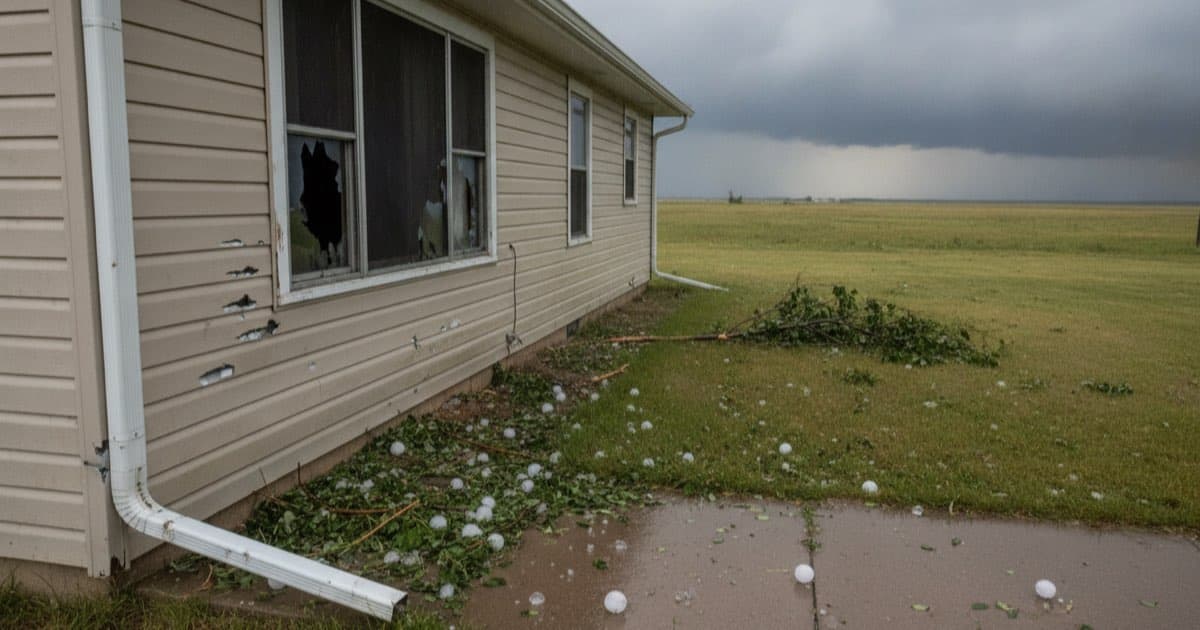
Short answer: many Scottsbluff policies carry a separate wind and hail deductible, and it is often a percentage of what your home is insured for rather than a flat sum. On a home insured for 300,000 dollars, 1 percent is 3,000 dollars. People discover this after the storm, standing in a driveway full of broken glass, which is the worst possible moment.
Almost everyone knows their deductible as one number, the one on the fridge magnet from their agent. Then hail comes through, the estimate arrives, and the figure the carrier subtracts is three or four times bigger than expected. Nothing has gone wrong. The policy simply has two deductibles, and the second one only wakes up for wind and hail.
Two deductibles, not one
The Nebraska Department of Insurance says it directly in its hail damage guidance for homeowners: some companies charge a higher deductible for wind and hail damage than for damage caused by other perils. That is the whole mechanism. A kitchen fire and a hail storm can be settled against two different numbers on the same policy.
The second difference is how the number is written. A flat deductible is a fixed dollar amount that stays put. A percentage deductible is a share of your dwelling coverage limit, which the Department's homeowners insurance guide describes as catastrophe deductibles represented by percentage rather than dollar amount.
What the difference actually costs
Worked through, on a home insured for 300,000 dollars. These are arithmetic examples with the inputs stated, not figures about what homes here are worth:
- Flat 1,000 dollars. A 14,000 dollar roof settles at 13,000 dollars to you.
- 1 percent wind and hail. The deductible is 3,000 dollars. The same roof settles at 11,000 dollars. You are 2,000 dollars worse off than you expected.
- 2 percent wind and hail. The deductible is 6,000 dollars. The same roof settles at 8,000 dollars, and your out-of-pocket cost has gone up sixfold against the flat figure you had in mind.
There is a quieter consequence. A percentage deductible is tied to your dwelling limit, and many policies raise that limit automatically each renewal to keep pace with rebuilding costs. The percentage stays the same while the dollar figure it produces creeps upward, year after year, without a letter drawing your attention to it. A number you checked when you bought the policy in 2019 is not the number you have now.
How to find yours in about two minutes
Pull out the declarations page, the summary sheet at the front of the policy, and find the deductible section. You are looking for two things rather than one: an all-perils or all-other-perils deductible, and a separate wind and hail line. If the wind and hail line carries a percent sign, find the Coverage A dwelling limit on the same page and multiply. That product, not the flat number above it, is what a hail claim will actually cost you.
If the two lines seem to contradict each other, call your agent and ask them to state the wind and hail deductible in dollars as of today. Get it in writing. It is a 5 minute call in January and a very expensive surprise in June.
An offer to cover your deductible is a warning sign
After a storm, someone will offer to make your deductible disappear. In Nebraska that offer is not a favour, it is a legal problem. Neb. Rev. Stat. 44-8604 states that a residential contractor shall not promise to rebate any portion of an insurance deductible as an inducement to the sale of goods or services. The statute goes further and defines what counts, closing the obvious workarounds: granting any allowance, offering any discount against the fees to be charged, or paying the insured any other form of compensation, beyond an item of nominal value.
So the friendly versions are the same thing in different clothing. "We will cover your deductible." "We will discount the job by exactly your deductible." "We will write the estimate a little high and you keep the difference." That last one is not only covered by the statute, it is insurance fraud with your name on the claim, not the contractor's.
Read it as information about the contractor rather than about the deductible. A company that opens by proposing something unlawful is telling you how the rest of the job will go. Worth pairing with a local quirk: Scottsbluff does not license roofing contractors, and its registration is a filing rather than a vetting, so the city is not screening this for you.
The renewal trap nobody mentions
One more line from the Department's hail guidance is worth knowing before you file anything. If you believe repairs will cost less than your deductible, you may not want to file a claim, and some insurance companies will consider occurrences of wind and hail damage, even if no money was paid out, when they review whether to renew your policy.
Read that twice. A claim that paid you nothing can still count against you at renewal. With a percentage deductible the odds of a nothing claim go up, because the bar the damage has to clear is higher. That is the practical argument for having somebody walk the roof and tell you what the damage is worth before you pick up the phone to your carrier, rather than after.
Why this matters more in Scottsbluff than most places
A wind and hail deductible is a background detail in a place that rarely gets hail. Here it is not background. In Scottsbluff itself, the NOAA NCEI Storm Events Database recorded 43 reported hail events between 2017 through 2026, of which 33 produced stones of 1 inch or larger, the size at which asphalt shingles start bruising. The largest measured 3.5 inches on 23 June 2023.
At that frequency the question is not whether the wind and hail deductible will ever apply to you. It is whether you will know the number before it does.
What to do with this
Check the declarations page this week rather than after the next storm. If the wind and hail line is a percentage, work out today's dollar figure and decide whether you can absorb it, because that is the real question a percentage deductible asks. If you cannot, that is worth a conversation with your agent about the tradeoff between deductible and premium while the sky is clear.
When a storm has already been through, the Nebraska storm damage claims guide covers the rest of the process: your filing deadline, your right to cancel a contract signed after a storm, and what our Scottsbluff office does on a claim. We inspect for free and tell you what the damage is actually worth, including when it is worth less than your deductible and you are better off not filing.
Frequently Asked Questions
What is a wind and hail deductible?
It is a separate deductible that applies only to wind and hail losses, and it is often larger than the deductible for everything else on the policy. The Nebraska Department of Insurance puts it plainly in its hail damage guidance: some companies charge a higher deductible for wind and hail damage than for damage caused by other perils. In hail-exposed country like the Panhandle it is common enough that you should assume you have one until you have checked.
What is the difference between a flat and a percentage deductible?
A flat deductible is a fixed dollar amount, such as 1,000 dollars, and it does not change when your home's insured value goes up. A percentage deductible is a percentage of your dwelling coverage limit, so it moves with that limit every renewal. The Nebraska Department of Insurance describes these as catastrophe deductibles represented by percentage rather than dollar amount. On a home insured for 300,000 dollars, a 1 percent wind and hail deductible is 3,000 dollars and a 2 percent deductible is 6,000 dollars.
How do I find out which one I have?
Look at the declarations page, the summary page at the front of your policy. Read the deductible line carefully: a policy can show a flat all-perils deductible and a separate wind and hail deductible expressed as a percentage, and the percentage one is easy to skim past. If the wind and hail line shows a percent sign, multiply it by your Coverage A dwelling limit on the same page to get the real number. Call your agent if the two lines seem to conflict.
Can a roofing contractor pay or waive my deductible in Nebraska?
No, and an offer to do it is a warning sign about the contractor. Neb. Rev. Stat. 44-8604 states that a residential contractor shall not promise to rebate any portion of an insurance deductible as an inducement to the sale of goods or services, and it defines that to include allowances, discounts against the fees charged, and any other form of compensation beyond an item of nominal value. Commercial Roofing Contractor never waives, pays, or rebates deductibles.
Should I file a claim if the repair costs less than my deductible?
Usually not, and the Nebraska Department of Insurance says so directly: if you believe repairs will cost less than your deductible, you may not want to file. There is a second reason beyond the obvious one. The Department also notes that some insurers count wind and hail occurrences when deciding whether to renew your policy, even when no money was paid out. A free inspection that tells you the repair is under your deductible is worth having before you file anything.
Does a percentage deductible go up on its own?
Effectively yes, and this is the part that surprises people. Because it is a percentage of your dwelling coverage limit rather than a fixed sum, it rises every time that limit rises. Many policies increase the dwelling limit automatically each renewal to keep pace with rebuilding costs, so a 1 percent deductible quietly becomes a larger dollar figure year after year without anybody sending you a notice about it. Check the current number after any renewal, not once.

Talk to the team nearest you: our Denver office, our Grand Junction office, or our Scottsbluff office.