Commercial Roofing Contractor provides commercial and residential roofing, roof replacement, repair, and hail damage work in Highlands Ranch, Colorado from our Denver office. Highlands Ranch is unincorporated, so roofing here is permitted and inspected by Douglas County rather than by a town building department, and the county's rules differ from those of the incorporated towns around it. Every inspection we do here is free and no-obligation.
Roofing a Community With No City Hall
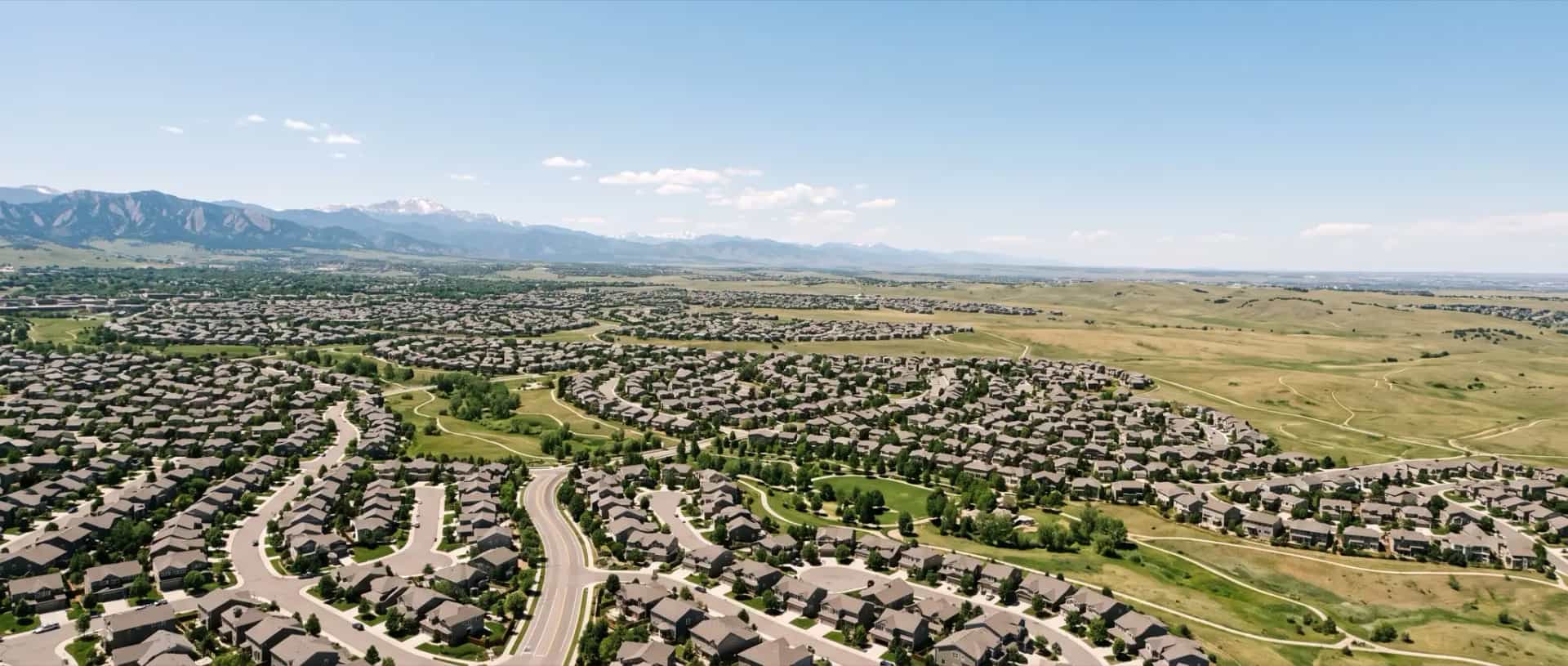
Highlands Ranch is one of the largest communities in Colorado without a municipal government. It is a census-designated place of roughly 100,000 people sitting between about 5,700 and 5,830 feet on the south edge of the Denver metro, bounded by C-470 to the north and running south toward Castle Pines, which unlike Highlands Ranch runs its own building department. It has no city hall and no building department, so the Douglas County Building Division permits and inspects every roof here, and the Highlands Ranch Community Association governs what those roofs are allowed to look like.
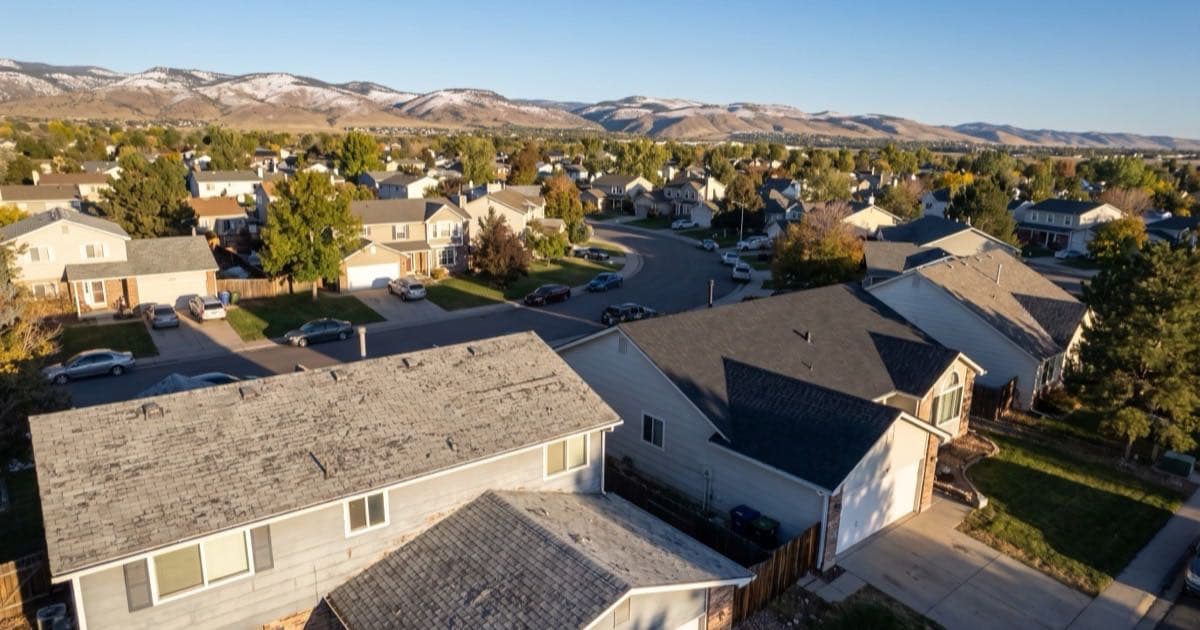
That combination is what makes roofing here different from anywhere else we work. Two separate approvals can apply to one job: the county permit, which is about how the roof is built, and the HOA architectural review, which is about material, colour and style. They run on different timelines and neither substitutes for the other. The housing stock is largely 1980s onward across Northridge, Westridge, Southridge and Eastridge, which means a great many roofs reaching replacement age at similar times, alongside office, retail and light industrial buildings along Highlands Ranch Parkway and County Line Road.
Roofing Codes and Permits in Highlands Ranch
Roofing work in Highlands Ranch is permitted and inspected by the Douglas County Building Division (303-660-7497). Colorado has no statewide roofing code, so requirements are set jurisdiction by jurisdiction and genuinely differ between neighbouring towns. The details below are taken from the Douglas County Building Division's published requirements.
Worth knowing in Highlands Ranch: Highlands Ranch is unincorporated, so there is no town hall to permit through: Douglas County is the authority for every roof here. That is the opposite of nearby Castle Rock, which is a town inside the same county running its own code, and the two are not interchangeable. Wood shingles and shakes are prohibited outright in unincorporated Douglas County, which deleted both code sections entirely. Existing wood roofs may only be patched, and only where the repair is under 25 percent of the roof area. Douglas County also requires a standalone drip edge inspection on asphalt roofs, with published dimensions, which neighbouring jurisdictions do not, and caps roof systems at 600 pounds per 100 square feet without a structural engineer's analysis.
Commercial roofing code in Highlands Ranch
| Requirement | Requirement in Highlands Ranch |
|---|---|
| Adopted code | 2024 International Building Code, as amended by Douglas County |
| Energy code | 2024 International Energy Conservation Code, climate zone 5B |
| Current codes effective | July 1, 2026. |
| When a permit is required | A permit is required to repair or replace one roofing square, 100 square feet, or more. Each separate structure needs its own roofing permit, except a one-story detached accessory building under 200 square feet. Work that is exempt from a permit must still comply with the county wildfire code where it applies. |
| Ice barrier | Required only above 7,000 feet, and Highlands Ranch sits at roughly 5,700 to 5,830 feet, so it is not required here. This is worth knowing because Castle Rock, twelve miles away in the same county, requires an ice barrier on every asphalt shingle roof. Douglas County ties the requirement to elevation; the towns inside the county set their own rules. |
| Overlay and recover | One layer only. An asphalt shingle roof may not be overlaid with another layer of asphalt shingles, so a replacement means tearing off down to the deck. Douglas County reaches that result by keeping the roof-recover section and adding asphalt shingle to the coverings you cannot recover over, where Castle Rock deleted the section outright. Same outcome for a shingle roof, different mechanism. |
| Mid-roof inspection | Required only for batten systems, meaning tile, slate, stone-coated steel or any system using battens, and it must be done at 25 to 50 percent complete. Asphalt roofs instead get a separate drip edge inspection, and every roofing permit gets a final. |
| Contractor licensing | Douglas County requires contractor registration before a building permit will be issued, and roofing is its own registration class. There is no test, and registration fees are currently waived. Registration must be complete before the permit issues, and it expires annually. |
| Design wind speed | 115 mph ultimate design wind speed for Risk Category II, with Exposure C for the whole unincorporated county. Asphalt shingles below 7,000 feet need a minimum 90 mph Class D wind rating, and high-wind nailing is required only above 7,000 feet, so not in Highlands Ranch. |
| Design snow load | 30 psf at Highlands Ranch elevation. Douglas County bands snow load by elevation at the top of the foundation and increases it 5 psf per 500 feet above 6,000 feet, and it allows no reduction from ground to flat-roof snow load. Ground snow equals roof snow here. |
| Frost depth | 36 inches |
Residential roofing code in Highlands Ranch
| Requirement | Requirement in Highlands Ranch |
|---|---|
| Adopted code | 2024 International Residential Code, as amended by Douglas County |
| Energy code | 2024 International Energy Conservation Code, climate zone 5B |
| Current codes effective | July 1, 2026. |
| When a permit is required | A permit is required to repair or replace one roofing square, 100 square feet, or more. Each separate structure needs its own roofing permit, except a one-story detached accessory building under 200 square feet. Work that is exempt from a permit must still comply with the county wildfire code where it applies. |
| Ice barrier | Required only above 7,000 feet, and Highlands Ranch sits at roughly 5,700 to 5,830 feet, so it is not required here. This is worth knowing because Castle Rock, twelve miles away in the same county, requires an ice barrier on every asphalt shingle roof. Douglas County ties the requirement to elevation; the towns inside the county set their own rules. |
| Overlay and recover | One layer only. An asphalt shingle roof may not be overlaid with another layer of asphalt shingles, so a replacement means tearing off down to the deck. Douglas County reaches that result by keeping the roof-recover section and adding asphalt shingle to the coverings you cannot recover over, where Castle Rock deleted the section outright. Same outcome for a shingle roof, different mechanism. |
| Mid-roof inspection | Required only for batten systems, meaning tile, slate, stone-coated steel or any system using battens, and it must be done at 25 to 50 percent complete. Asphalt roofs instead get a separate drip edge inspection, and every roofing permit gets a final. |
| Contractor licensing | Douglas County requires contractor registration before a building permit will be issued, and roofing is its own registration class. There is no test, and registration fees are currently waived. Registration must be complete before the permit issues, and it expires annually. |
| Design wind speed | 115 mph ultimate design wind speed for Risk Category II, with Exposure C for the whole unincorporated county. Asphalt shingles below 7,000 feet need a minimum 90 mph Class D wind rating, and high-wind nailing is required only above 7,000 feet, so not in Highlands Ranch. |
| Design snow load | 30 psf at Highlands Ranch elevation. Douglas County bands snow load by elevation at the top of the foundation and increases it 5 psf per 500 feet above 6,000 feet, and it allows no reduction from ground to flat-roof snow load. Ground snow equals roof snow here. |
| Frost depth | 36 inches |
This is a summary to help you plan, not a compliance determination. The Douglas County Building Division is the authority on what your specific roof requires, and we always confirm current requirements with them before we scope a job. Several Colorado jurisdictions changed their adopted codes during 2026, so we re-verify against each department's own published codes rather than working from memory. Source: Douglas County Resolution R-026-021 (adopted 24 March 2026), the county's 2024 IBC and IRC amendment documents, the Douglas County Wildfire Resiliency Code, and the county's roofing permits, inspections and contractor registration pages (read the source document). Last verified July 2026.
Wildfire code: what changes on a reroof
The 2025 Colorado Wildfire Resiliency Code applies here, and Highlands Ranch is a specific case: the county ties the required roof covering to that code's map rather than applying one rule county-wide. In areas the map rates low, moderate or high fire intensity, the roof covering must be Class A fire resistance rated. Everywhere else in the unincorporated county the minimum is Class C. There is no unrated option either way, which is unusual: most Colorado jurisdictions apply a wildfire standard only inside mapped areas and leave everything outside them to the base code.
The new-construction standard means roofs must have a covering or assembly classified Class A when tested to ASTM E108 or UL 790. Where the covering profile leaves a space above the deck, that space must resist flames and embers by noncombustible firestopping, an ASTM D3909 cap sheet over the combustible deck, or a listed Class A assembly. That last requirement catches tile and metal profiles, not just shingles, so it reaches commercial work as well as homes. Because the standard here is set by where your address falls on the map rather than by a single city-wide rule, the intensity band is the first thing to establish on a Highlands Ranch reroof, and we confirm it with the Building Division before quoting a covering.
For the full picture on storm-driven replacement, see our storm damage and insurance claim guidance.
Recorded Hail in Highlands Ranch
Between 2017 through 2026 the NOAA NCEI Storm Events Database recorded 25 reported hail events in Highlands Ranch, of which 18 produced stones of one inch or larger. The largest on record measured 1.5 inches on 8 July 2023. Highlands Ranch ties Greeley for the most reported events in our service area but with a lower ceiling, so the pattern here is frequency rather than extremes: repeated damaging-size hail rather than the occasional very large stone.
One inch is the size at which asphalt shingles typically start bruising, which is why that count matters more than the raw number of storms. Bruising fractures the mat under the granules and often leaves no obvious hole, so a roof can be functionally compromised while still looking intact from the driveway. That is what we look for on an inspection, and we photograph what we find so you have documentation before deciding anything.
Figures are reported events from the NOAA NCEI Storm Events Database, 2017 through 2026, retrieved August 2026. NCEI records storm reports filed for a named location, so the real number of hail events over any given roof may be higher than the reported count.
One County, Three Different Answers
It is easy to assume that a Douglas County address means Douglas County rules. It does not. The county code applies to the unincorporated area only, expressly excluding anything inside the limits of a city or town, so the incorporated towns write their own. The result is that three neighbours a few miles apart follow three different rulebooks, and the ice barrier question, which decides real money on a shingle job, gets three different answers.
- Highlands Ranch, unincorporated: no ice barrier required, because the county sets that requirement above 7,000 feet and Highlands Ranch sits about 1,200 feet below the line.
- Castle Rock: ice barrier required at eaves and valleys, and the town deleted the roof-recover section outright.
- Parker: no ice barrier required, no asphalt shingle overlays, and a mid-roof inspection required on membrane and flat roofs but not on shingles.
This is the practical reason we do not quote from a standard spec. A contractor working from a Castle Rock job sheet in Highlands Ranch is pricing an ice barrier nobody requires, and one working the other way is leaving out something the town does.
Roofing Services We Provide in Highlands Ranch
- Residential roofing - asphalt shingle (including Class 4 impact-resistant), metal, tile, and synthetic slate and shake, specified with the county's roof weight limit in mind.
- Commercial roofing services - TPO, EPDM, metal, modified bitumen, and roof coatings for office, retail and light industrial buildings.
- Multi-family and HOA roofing - townhome and condominium associations, where the architectural approval and the county permit both have to be sequenced.
- Storm and insurance claim support - free damage documentation and adjuster coordination for both commercial property claims and residential homeowner claims, which are scoped and settled differently.
Nearby South Metro Communities We Serve
Frequently Asked Questions
Do you have an office in Highlands Ranch, CO?
Highlands Ranch is served by our Denver office at 5300 Broadway, a straightforward run down I-25 and C-470. Our crews and inspectors work the south metro year-round, and inspections are free with no obligation. Call (720) 893-7663 to schedule.
Who issues a roofing permit in Highlands Ranch?
The Douglas County Building Division, at 303-660-7497. Highlands Ranch is an unincorporated community rather than an incorporated town, so it has no building department of its own and the county is the permitting authority. That is a genuine difference from Castle Rock and Parker, which are incorporated towns inside the same county that adopt and enforce their own codes.
Is an ice barrier required on a Highlands Ranch roof?
No. Douglas County requires an ice barrier only above 7,000 feet, and Highlands Ranch sits at roughly 5,700 to 5,830 feet, well below that line. This is the clearest example we know of that one county is not one set of rules: Castle Rock, twelve miles away and in the same county, requires an ice barrier on every asphalt shingle roof because the town sets its own. Where the county's rule does apply, the barrier runs from the lowest roof edge to at least 24 inches inside the exterior wall line.
Can I put new shingles over my existing roof in Highlands Ranch?
No. Douglas County permits one layer only, and an asphalt shingle roof may not be overlaid with another layer of asphalt shingles, so a replacement means a full tear-off to the deck. Interestingly the county gets there by a different route than Castle Rock: Castle Rock deleted the roof-recover code section entirely, while Douglas County kept it and added asphalt shingle to the list of coverings you cannot recover over. Same answer for a shingle roof, different mechanism.
Are wood shake roofs allowed in Highlands Ranch?
No. Unincorporated Douglas County deleted the wood shingle and wood shake code sections outright, so they cannot be installed. An existing wood roof may be repaired only where the work covers less than 25 percent of the total roof area, and any replacement material has to carry at least a Class C fire rating. If you have an older shake roof, this generally means the next full replacement will be a different material.
What inspections does a Highlands Ranch reroof need?
Every roofing permit gets a final inspection. Asphalt and composition roofs also get a separate drip edge inspection, which is unusual and which neighbouring jurisdictions do not require. A mid-roof inspection applies only to batten systems, meaning tile, slate or stone-coated steel, and has to happen between 25 and 50 percent complete. The permit holder has to leave a secured ladder on site on the day of the inspection.
Does my roofer need to be registered with Douglas County?
Yes. The county requires contractor registration before it will issue a building permit, and roofing is its own registration class. There is no test and the registration fees are currently waived, but it must be in place before the permit issues, so it is worth confirming your contractor is registered rather than discovering it at permit time.
Does my HOA need to approve a roof replacement in Highlands Ranch?
Quite possibly, and you should assume it needs checking. The Highlands Ranch Community Association's own improvement guidelines require Architectural Review Committee approval for improvements that change a building's exterior appearance, and the roofing section states that ARC approval may be required and that a sample showing colour, style and material may be requested. Certain sub-associations have more restrictive covenants and their own separate process. The HRCA has 30 days to act once it has everything, so build that into your timeline rather than treating it as a formality.
Does Highlands Ranch get hail?
Frequently. Between 2017 and 2026 the NOAA storm records list 25 reported hail events in Highlands Ranch, 18 of them producing stones of one inch or larger, which ties it with Greeley for the most reported events anywhere in our service area. The pattern here is frequency rather than extremes: repeated damaging-size hail rather than the occasional very large stone. One inch is where asphalt shingles typically start bruising, which is what we look for on an inspection.
What commercial roofing do you do in Highlands Ranch?
Low-slope and flat commercial systems: TPO, EPDM, modified bitumen, metal, and fluid-applied roof coatings for the office, retail and light industrial buildings along the Highlands Ranch Parkway and County Line Road corridors, plus HOA and multi-family work. Commercial roofs are reviewed under the International Building Code path, and Douglas County left the commercial roofing chapter unamended, so the base 2024 code governs there.
What residential roofing do you do in Highlands Ranch?
Asphalt shingle including Class 4 impact-resistant products, metal, tile, and synthetic slate and shake. Given how often hail is reported here, Class 4 is worth a conversation even though Douglas County does not require it and offers no incentive for it. Note the county caps roof systems at 600 pounds per 100 square feet without a structural engineer's analysis, which matters if you are moving from shingle to tile.
See all roofing FAQs. Grouped by topic: commercial and residential decisions, cost, insurance claims, storm response, warranties, and financing.
← Back to our Denver office (5300 Broadway, Denver, CO 80216, (720) 893-7663)